• Twitter
  • Facebook
  • LinkedIn
  • Contact us
  • My Account
  • Cart
  • Checkout
  • 0Shopping Cart
DCS Robin L. Cabral, MA, CFRE | Hire a Fundraiser
  • About Robin
  • Products
    • Webinars
  • Resources
    • Blog
      • Board development
      • Campaigns
      • Donor relations
      • Grant Writing
      • Individual Giving
      • Major gifts
      • Online
      • Planning
      • Small shop fundraising
    • Subscribe to Newsletter
    • Videos
  • Speaking
    • Topics
    • Testimonials
  • Community
  • Services
    • Coaching with Robin L. Cabral, MA CFRE, MFIA
    • Consulting
    • Hire a Grant Writer
    • Hire a Fundraiser
    • Speaking topics
    • Clients
    • Testimonials
  • Australia Office Services
    • Visit our Australian website
  • Search
  • Menu Menu

Posts

Blog, Campaigns, Capital Campaigns, Direct mail, Grant Writing, Individual Giving, Major gifts, Planning, Resources for the professional, Small shop fundraising

How to create a quick and easy fundraising plan to help you reach your goals

So, maybe you have been operating without a plan up until now.  And, that is ok, but it is not strategic, and to meet your goals, you need to have a plan that you follow, monitor, and correct if needed.

Here are some simple instructions on how you can quickly create a development plan if you have been operating without one.

  1.  Develop a gift table.  A gift table outlines the number of gifts needed for you to reach your fundraising goals.  And, yes, even small fundraising goals should have a gift table created.  So, for instance, if you have a goal of $50,000, you would need a top gift of $12,500.  I have another article on how to use a gift chart to guide your fundraising effort.
  2. Once you have your gift chart created, it will guide your strategies.  Take that gift table and think about how you are going to raise your top gifts.
  3. Then break out all the possible fundraising strategies into key categories.  Those key categories may be major donors, individual donors, Board giving, special events, corporation and businesses, private grants, government grants, and earned revenue.
  4. Plan on how many you are going to solicit from each category and how i.e. individual donors you may send out a lapsed donor appeal, an annual renewal appeal, and perhaps a prospective donors appeal using direct mail appeal and maybe phone follow-up.  Your complete mail out will be close to 1,000.  You can even go a step further and calculate the average gift amount if you are able.
  5. From the numbers that you will be soliciting and the calculated average gift amount determine what your estimated income will be.  Know or have any expenses, calculate those and subtract them from your expected income, and you have a net income number.
  6. Then the last key element of this plan is to determine when you will complete each strategy by and who is responsible for the strategy i.e. development staff, executive direct, Board of Directors, etc.
  7. Then implement your plan. But, most importantly use this plan as a monthly monitoring tool.  Share it at your Management Staff meetings and with your Development Committee or the Board of Directors.  If it appears as if you are “off” on projections, make mid-course corrections and adjust your budget.
  8. But, don’t let this sit on a shelf.  Get it in action.

You may want to consider putting all of the key plan information in a spreadsheet to have it all in one place.  Or you can use a Word document table.  Whatever format you use, start with the gift table, develop the plan, keep this plan in a prominent place, share it and monitor it, and make mid-course corrections.

You can’t operate successfully without a plan in place to drive and focus your effort

Then you will be on your way to reaching your yearly fundraising goals.

And, if you need help creating this development plan, let us help you!  Email me today to schedule an hour to get your development plan in shape!

May 6, 2017/0 Comments/by hireacfre
Blog, Campaigns, Capital Campaigns, Individual Giving, Major gifts, Planning, Resources for the professional, Small shop fundraising

How you can find prospective donors for even your small nonprofit

One may think that there are only a limited number of donors to go around, but think again.

In my work, I assist small to mid-sized organizations in running their first capital campaigns. Many do not have established donor bases to tap into for an already existing pool of major donors. So, I assist. And, I am here to say that yes, you too can, even in your small nonprofit, develop a list of 25 or more possible major donors to your organization.

I am going to take you step by step on how to begin establishing that prospect list for your nonprofit organization and then share with you some next steps on how to prioritize that list.
Here are the steps you can take to develop your prospect master list:

  • Use informal organizational networks including organizational friends and family members i.e. Board members, staff, volunteers, etc. to identify prospects within their respective networks who have both wealth and affinity for the cause.
  • Ask your current donors when meeting with them if they know of anyone else who may support the cause.
  • Research prominent donors to other similar organizations who may be making small gifts to your organizations. It is helpful to obtain copies of their annual reports, newsletters, and even event programs to see the giving levels of the prospective donors. Annual reports may be found online or hard copy by request.
  • Research who has been attending your events. There are folks here who already know of your mission and may be willing to deepen their relationship with you.
  • Research others who live in your community who might give to you using voter, property (Grand), the local chamber of commerce, houses of worship, and other lists.

So now what do you do when you have all this information?

Here is what I recommend:

Cull through all these lists to create a Master List of prospects whom you think “make the cut” regarding any possibility of capacity, affinity, or connection.r

Let me define these for you.

  • Capacity – ability to give
  • Affinity – philanthropic to a similar cause or interest
  • Connection – involvement in your organization

Once you have this Master List developed then work with the fundraising/development committee, Board of Directors, or other volunteers (they should know folks in the community) to rate and rank each donor during a rating session to determine potential giving capacity, interest, and affinity.

Then, organize lists of donors into tiers of giving to decide who is approachable first, those needing further cultivation, etc.  I just happen to like this worksheet right here!

And, from there you have a Master List of the top 20-25 prospective donors to your organization.  Even the smallest of non-profit organizations should be able to come up with a Master List of at least 25 potential donors after following these steps.

And, if you need someone to help build your prospect list for your next fundraising campaign, Development Consulting Solutions is always here for YOU!


April 15, 2017/0 Comments/by hireacfre
Blog, Campaigns, Capital Campaigns, Direct mail, Grant Writing, Individual Giving, Major gifts, Online, Planned Giving, Planning, Resources for the professional, Small shop fundraising

How a gift range chart can help you raise more money even in your small nonprofit

One might think that gift range charts are just for large projects such as capital campaigns or for significant fundraising efforts.  And, while, yes, there is some truth to that, gift range charts can be used effectively in even the smallest of fundraising shops.

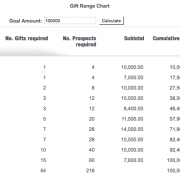
A gift range chart will tell you exactly how many gifts AND prospects you need at each giving level to reach your goal. And, it also shows you the potential to reach your fundraising goal.

So, first, how do you create one?

  • Well, you can use any online calculator to do so.  I highly recommend the simple and easy to use Blackbaud gift range calculator.  You can find that tool here.
  • A gift range chart calculator is only going to provide you with an estimate. If you want to be more accurate, you may want to create the chart on your own using the given realities of your organization.  So, how do you go about creating your own?  Well, you will want to identify the highest level gift to your fundraising efforts.  That will probably be somewhere in the area of 20% of goal.  Estimate 3-5 prospective donors per gift.  Fill in your chart downwards based on what you know about your donors and their capacity.  Gift amounts go down, and the number of donors increases.

So, here is what a $100,000 fundraising goal would look like: https://www.blackbaud.com/nonprofit-resources/gift-range-calculator

How do you now use this information to inform your strategy?

  1. I would first look at the top gifts needed.  Here in this example, you would need 1 – $10K, 1 – 7.5K, 2 – $5K, and 3 – $3.5K for a total of $38K.  There are several options, right? You could write several grants.  In this case, you would need 28 grant possibilities, or you could approach a few major donors.
  2. Then if you look at your next tier of gifts, you would need $34K in gifts.  Perhaps you have a fundraising event, or maybe a direct mail campaign or a series of direct mail campaigns.  Or perhaps you continue to ask for gifts at this level.
  3. Maybe you look even further down and realize that you have a series of direct mail appeals, or that one appeal will do it for the remainder of the $28K or so.

The fact of the matter is that any possibility of a strategy will work, as long as it is realistic and fits for your organization. The key thing to remember is that you want to secure the top gifts first.  If you don’t raise those, then you need to readjust all the lower levels of the gift range chart below to “make up” for the difference.

Then, you can use this gift range chart as a monitoring and reporting tool. Let’s say that you are not hitting your “lead” gift targets.  Well, you can certainly adjust this gift range chart mid-course and make the necessary adjustments to your strategy BEFORE your fundraising efforts get too far off track.  And, this would be a great tool to share with your Board of Directors to educate them on the process of raising money and how your particular efforts are progressing towards projections.

So, though you may think that gift range charts are for the “big shops,” think again, a gift range chart can provide even the smallest campaign with focus and goals based on actualities and realities.

So, this next fiscal year why don’t you first start by creating a realistic gift range chart for your annual fund campaign and develop strategies to get you to your goal.


SaveSave

SaveSave

SaveSave

April 9, 2017/0 Comments/by hireacfre
Blog, Board development, Planning, Resources for the professional, Small shop fundraising

Is it time to close our nonprofit doors?

As a nonprofit organization, you are here to meet a mission to your stakeholders.  Maybe long ago, or not so long ago, you were founded to assist a particular group or meet a critical need.  And, months go by, years go by, and you are still in existence.  But, is the need still there?  Are you still relevant towards meeting that need?

Sometimes, we just don’t want to answer this question.  Because in answering it, you may find, that yes, indeed, you have met your mission or, in fact, are no longer relevant, or facing a crisis, or maybe even just plain exhausted and lack energy as an organization.

Is it time to dissolve perhaps?  Maybe merge with a similar group?  Shutting down is not the only option, but it is one.

Let’s face it, was it ever our intent to be here forever?

Hopefully not.

In admitting that you have met your mission, you have done exactly what you have set out to do.  And, more and more nonprofits are choosing this route, admirably I may add.

Ultimately, though, this is a larger Board discussion.

Why?

Because the Board of Directors is directly responsible for the organization’s future:  whether to grow, change, downsize, merge, evolve, or close.  This is governance at its most important and highest level.

Here are some important questions to explore as a Board before you do:

  • Are we meeting our stated mission?
  • Are we helping our intended audience?
  • Are we still relevant to our community?
  • What is the situation that is precipitating this discussion?  Are we tired, lack energy?  Financial constraints?  No longer needed?
  • What would be the implications if we did no longer exist?
  • Do we want to continue?  Can the organization be saved?
  • Have we simply run out of steam and need to close down?
  • Is it time to let us fail instead of always trying to “right” the ship?
  • Do we have adequate human resources to keep things going and are they the right people?

After seriously reflecting on these questions, a nonprofit Board can choose to take several routes.

  • You can choose to change your mission statement to reflect who you are and what need you are truly meeting.
  • You can choose to restructure your operations, programs, and activities to lead to a better functioning organization.
  • You can find a similar nonprofit organization in mission and merge.
  • If under undue financial stress, you may consider filing for bankruptcy
  • Or, if you are just tired or having met your mission, you can cease to operate and dissolve.

Ultimately, the Board must recognize that a crisis situation exists, focus efforts on addressing this issue, and come to a consensus-based conclusion on which path is most appropriate to your mission, to the community you serve, and to yourselves as individual Board members.


March 25, 2017/0 Comments/by hireacfre
Blog, Campaigns, Capital Campaigns, Donor relations, Individual Giving, Major gifts, Planned Giving

What’s next after your capital campaign feasibility study?

So, your consultant has just finished your capital campaign feasibility study.  The report is sitting on your desk, and you are wondering, where do I go from here?

Here are some possibilities:

The report may recommend that the organization takes some time to prepare its fundraising infrastructure before going into full campaign mode. Preparation may include things such as strengthening volunteer leadership, identifying campaign chairs, enhancing their fund development office, etc.  The organization should take the time to heed these recommendations and work either internally or with the/a consultant to strengthen some of the key identified areas before mounting a full capital campaign effort.

In some cases, the report may recommend that the organization move into full capital campaign mode.  In that case, the agency should seek to hire outside counsel either the firm that conducted the feasibility study process or another fundraising firm specializing in capital campaign management.

This report should be presented to the Feasibility Study Committee for review and once accepted by this committee; the committee should then give the report to the organization’s full Board of Directors for approval.  Once the Board approves, it should move to act on the recommendation found in the study.

In no shape or form, should this study be allowed to slip away or be placed on a shelf somewhere.  Time for action is now.  You do not want to lose the interest of donors and other key community members who have been part of the process and in some senses cultivated for a capital campaign effort.

In fact, the organization should share an abbreviated format of the study with these key donors and community members, and seek their opinions and possible engagement in the findings and campaign next steps.  The worst thing that can happen is that momentum is built through the study process and then grinds to a halt.

Accept the report, begin recommendation implementation, and engage key stakeholders throughout the process.

March 18, 2017/0 Comments/by hireacfre
Small shop fundraising, Uncategorized

Characteristics of a good development director

Technical skill or personality, which is most important when hiring a new director of development?

That is a great question.

And, while ideally, both would be great, that is not always a guarantee.

So what do you look for in this case?

While just about anyone can have the skill set of a fundraiser, not everyone can have the temperament to be a superior director of development. It takes personality to make a professional difference. And, let’s be honest, not everyone has personality.

What kind of personality?

Well, development professionals must have a temperament suited to serving people’s needs. They must be attentive, persistent, and flexible. They need to have a thick skin and be willing to give others credit. A huge piece of the job is making others look good while taking the back seat to their ego. When they do their job well, no one knows it. They make an indirect not a direct contribution to accomplishments and very rarely if ever take the credit.

The best development professionals are servant leaders, putting the needs of the organization and those that they serve ahead of their very own. They are the voice of the donor within the organization and as a profession as a whole.

Since they are that voice for the donor, I then ask, what is it that donors expect in that person?

A recent article published on Guidestar stated that donors want someone who is passionate and enthusiastic about the mission, has high standards of integrity, authenticity, self-confidence, and most importantly someone who loves their work and shows it by their willingness to pay the price to get the job done with joy.

So don’t hire based just upon skill sets or certifications alone. You might not be satisfied with what you get. Delve deeper to determine if this person has the right attitude, temperament, and belief that will take your organization to the next level and meet the needs of your donors.

Shall I dare say, good development directors are not as easy to find? But bad ones are!

February 26, 2017/by hireacfre
Blog, Campaigns, Donor relations, Individual Giving, Major gifts, Planned Giving, Resources for the professional, Small shop fundraising

The revolving fundraising door at our organizations

What is going on out there?

For the past year, I have watched development jobs come and go on the job boards.

I lamented that folks like myself with over 20 years of experience, certifications, and education were getting passed up for the lower paid, less experienced, “greener” young ones.  And, there might be some thread of truth to that.  I can’t be all wet behind the ears.

But, the funny thing is lately, after a year of scanning job postings, I started to notice something very, very interesting.  The same postings were coming up.  A place down in Newport, a place in Dorchester, the same job, needing the same person.

It is so costly to keep having staff turnover.  Expensive in many ways.  Not just because of having to fill a vacancy, but costly to the organization as its donor base is disturbed.  Development is all about relationships, and if high staff turnover continues, those relationships are never truly built.

Another thing that I have noticed is that some organizations are being a bit more proactive.  Seeking out referrals for qualified candidates and then actively recruiting instead of waiting for candidates to apply and come to them.

The smarter move, I might add.

I guess I pen this manifesto for all those development professionals who have spent years in the field honing best practices and in some cases even developing them.  It is time that organizations stop looking for the cheapest, youngest, idealistic help.  It doesn’t serve the organization to cut the budget by hiring inexperienced newbies for its top position, particularly when it comes to fund development.  Can you afford to take a chance on someone who is “green” behind the ears to figure it out as they go along?

I think naught!  If you think differently, leave me a comment below.


January 28, 2017/1 Comment/by hireacfre
Blog, Campaigns, Direct mail, Donor relations, Individual Giving, Major gifts, Online, Planning, Resources for the professional, Small shop fundraising

Oh, the woes of a nonprofit fundraising database!

So, let’s talk database.

What? That seems like something so mundane. Well, it may be, but it is so critical to fundraising.

Throughout my professional career, I have been victim to bad databases, and I have been asked to work with bad databases.

One thing is for sure, without an initial thought out structure, problems are inevitable. I often come into organizations that have no rhyme or reason as to what they call their Campaigns, Funds, and Approaches. You know, one year it is called Spring Appeal 2016, and the next it is labeled the Mother’s Day Appeal.

Consistency is key. I see so much inconsistency that why bother having a database, to begin with at all. The way names are entered i.e. Mr. and Mrs. Smith or Bob and Laura or even Robin and Smitty or Robin & Smitty.

It drives me mad.

Having a database procedural manual developed with consistent data entry standards specified is critical. How do you pass this institutional information along when staff transition or do you? Do you let them sink or swim?

Hey, garbage in is only garbage out.

The most important thing is the question of who has access to this database? Who does the main gift entry? Moreover, I pray that your answer is a development staff person. Please, do not say that it is a member of the finance department, or even worse, a volunteer or an intern.

Provide those using the database with training in the software itself and budget for it every year. Moreover, don’t think that a cost saving is ignoring software updates and the resulting costs.

I cannot stress enough how important the database is to your fundraising efforts. It will allow you to be donor-centered in your work regarding recognizing donors and their giving the exact way that they want to be recognized. It lets you accurately report on giving and make comparisons that will affect the future of your fundraising efforts, and it will allow you to become more strategic in your endeavors through segmentation and greater personalization.In all of my career if I had to answer the question of “What impacts the success of fundraising THE most, besides the Board, of course,” I would have to answer, the database.

Moreover, folks EXCEL is not a database; it is a spreadsheet tool used by those in the finance department. Please don’t say that you cannot afford a database. Some great databases are available for a very fair and affordable price.

Pay close attention to your database – this is the brain behind your efforts.


January 21, 2017/1 Comment/by hireacfre
Blog, Campaigns, Direct mail, Donor relations, Grant Writing, Individual Giving, Major gifts, Online, Planned Giving, Planning, Resources for the professional, Small shop fundraising

New “DCS” interim development services

Development Consulting Solutions is announcing NEW interim and project-based service offerings:

Who is “DCS”?
There are limited Certified Fund-Raising Executives (CFRE) providing outsourced fund development services and serving as interim fund development staffing. What most organizations need is someone who can do the work for them!

“DCS” recognizes this need and has provided this service to a variety of small to mid-sized nonprofits throughout the New England region. Some of these nonprofits have included Malta House of Norwalk, CT, Friends of Buttonwood Park of New Bedford, MA, and United Methodist Elder Care of East Providence, RI.

“DCS’s mission”
“DCS” does not engage with everyone! We have a rigorous eligibility requirement and screening process and only work with four select clients at a time.

What are our requirements? We only work with small to mid-sized organizations that are ready, receptive, and willing to take their development program to the next level through outsourced assistance. These organizations have an engaged Board of Directors, an open-minded and willing staff, and leadership ready to support the organization.

We only work with organizations that are willing to invest in their development function, value established service costs, heed professional advice, and strategy, and act respectfully in the client and consultant relationship.

By selecting those clients most ready to embark on taking their organization to the next level, “DCS” provides you with the tools and staffing to raise more money in support of mission!

Why “DCS?”

  • To provide outsourced development expertise to organizations that do not want to hire someone in-house.
  • To assist busy executive directors with taking a few things off their plates.
  • To reassure donors during a transition or vacancy in your development office that your fundraising efforts will continue
  • If time is needed to do a search for a permanent development director, and you do not want to be rushed to make a selection
  • When you are seeking a new executive director and you want to be sure that this leader has an opportunity to select the permanent development director
  • Because as interim development director, I can have more candid conversations with the executive director, board, and other leaders about why there are problems with keeping development staff or staff is underperforming
  • When your organization has never had a development director and needs an experienced professional with a proven track record to start up the development office and pave the way for a more junior development officer to be successful.

Here is what “DCS” can do for you:

  • Assess current fundraising activities and make recommendations to improve strategy
  • Improve your fundraising efforts
  • Model what a good development officer does
  • Enhance systems and processes within the development office
  • Troubleshoot development problems
  • Coach the Executive Director and Board in fundraising to boost confidence and skill
  • Help with the hire of a permanent development director

“DCS” helps with:

  • Major Gifts
  • Direct Mail Appeals
  • Development print publications – your newsletter, annual report, brochures, etc.
  • E-Appeals and E-Newsletters
  • Grants
  • Cultivation and Stewardship Events
  • Special Events
  • Capital Campaigns

For “DCS” pricing, please check out our menu of packages here!

January 15, 2017/0 Comments/by hireacfre
Campaigns, Individual Giving, Major gifts, Resources for the professional, Small shop fundraising

Is it time to go public with our campaign? Maybe, maybe not!

When to go public?

A question that I am asked a bit. When can our capital campaign go public? When can we put a thermometer out on our lawn? When can we start to ask our constituents and the general community? When can we have a special event and invite everyone?

The all important question, “is it time?”

My answer? Not until you have a certain number of lead gifts in hand. And, not before you have your institutional family committed to the campaign – folks like your Board of Directors, staff members, Campaign Steering Committee members, and your leadership donors.

Only when you have the majority of lead and family gifts in, is it time to broaden the focus and extend the solicitation process to more prospects through a more public campaign. Some say that you should have at least 50-70% of the entire gifts needed for the campaign in hand. But, one thing is for sure, the “Quiet” Phase is that indeed – quiet. There is no general advertising of the campaign or overall campaign fanfare.

Once you have a significant number of advanced gifts in hand, it is at this juncture that you should plan a campaign kickoff celebration event to aid in your project going “public.” This “public” phase is when the work of soliciting the organization’s broader constituency begins.

Then and only then should you put that “Community Thermometer” in the ground and start having your special shindig events.

So, is it time to go public – maybe or maybe not.  It all depends upon the science of campaigns and it is not something that you want to rush.

January 7, 2017/0 Comments/by hireacfre
Blog, Planning, Resources for the professional, Small shop fundraising

A season of burnout?

I have worked in the nonprofit world far longer than I can remember.  My job began in the sector back in 1992 or so, when I became a grant writing intern for a local non-profit organization as part of my undergraduate work.

Little did I realize that some twenty plus years later, I would still be working in the sector.  First as a professional at local non-profit organizations and now as an industry consultant.  This week, I had cause to pause.  I received a telephone call last Friday evening that a former client of mine had passed away due to cancer.  I cried.  And, I cried.  And, I even cried some more.

Then, after a long season of constant deadline oriented projects, finally feeling a bit of downtime between clients, I became sick with the flu and was laid up in bed for several days, still weak as I write this article.  While sick in bed, I received another telephone call, someone else in my personal life had passed on, again due to cancer.

One thing I do know is that our work is long and hard.  And, we are often fighting for the lives of others in our sector.  But, does that mean that we don’t take care of ourselves?  Do we even stop a moment to breathe, to reflect, to take in the season that we are in, to spend time with our loved ones?

I am guilty of this.  I admit it.  I work tirelessly so that my clients can be the best that they can be.

This fall, I purchased a new book out by Beth Kanter, called the Happy Healthy Nonprofit.  I have yet to read it, of course, time has not allowed.  But, I am going to make it priority reading over the upcoming Christmas break.  And, I suggest that you pick up a copy too.  There are lessons in this book about self-care, taking the time to recharge, and not burnout out.  Let’s face it; our sector is a sector of burnout.

If you can do one thing right now, stop, get up, walk around – thank your employees, take in the sights and sounds of the season, perhaps take the afternoon off, hug a loved one, give someone close to you a call just to say “hi!”  There is more beyond our work than our nonprofit.  Yes, I said it.  And, if you don’t rest and recharge, there will be little else for you to give to others.

This week, I pause and remember my former client, Fr. Stan Kolasa of the Sacred Hearts Retreat Center in Wareham, MA, I take the time to honor his life and his legacy.

And, I take the time just to be – in the season and the moment.  And, I urge each of you to do the very same.

Reflect on your life, and take good care.  The fight always goes on, but it only goes forward when you are stronger.

December 10, 2016/2 Comments/by hireacfre
Blog, Board development, Campaigns, Direct mail, Donor relations, Grant Writing, Individual Giving, Major gifts, Online, Planned Giving, Planning, Resources for the professional, Small shop fundraising

Do not take Fund Development best practices at face value!

Best practices. We hear that phrase often. This week, I even read a question asking if “best practices were misleading?”

Are we throwing that phrase around to legitimize our field? Our do we have best practices and what are they?Fundraising best practices

Well, I contend that the only true best practice is one that is grounded in research. Those are harder to find that than the other so-called “best practices.”

While studying for my Masters Degree in Philanthropy and Fund Development, I learned that philanthropic research has many gaps. However, there are people now making a study of philanthropy and conducting research. Folks like Adrian Sargeant and Jen Shang. More research is needed in our field to support our work.

I can tell you that when research is grounded in actual studies, it works. Eye motion studies, philanthropic psychology, etc., etc.

Recently, I have been working on many appeal letters. And, each time I craft one for the client, I get pushback. Why do you indent paragraphs? Why do you repeat yourself often? Why is there bold and underline? Do we need to include a P.S.? And, can’t the letter just fit on one page? Must we send more than one appeal?

Pushback that is unfounded. And, I push back with research. When the client allows me to use those best practices, the results speak for themselves.

When those results speak for themselves, it is magic. Campaigns get funded, new projects begin, and donors have the opportunity to make a greater impact.

We forget that the fact (and it is a fact) that we are not beggars. Donors want to give. And, to give, they must be asked. Asked in a way that moves them to feel connected to their core beliefs through your organization’s mission.

Know the difference between unfounded best practices and best practices backed by scientific research. Read blogs, stay current with trends, and keep furthering your informal and formal education. When you do, and you practice it, your results will show all the difference.

Fund development does have a researched body of knowledge. Don’t allow anyone to convince you that it does not.

December 3, 2016/0 Comments/by hireacfre
Page 2 of 6‹1234›»

Like DCS on Facebook

Latest Posts

  • 5 Tips for Converting Crowdfunders to Lifetime DonorsMarch 24, 2022 - 2:06 am
  • Here’s the Checklist You Need to Create a Communications Plan for your Nonprofit’s Next Fundraising Campaign!Here’s the Checklist You Need to Create a Communications Plan for your Nonprofit’s Next Fundraising Campaign!March 11, 2022 - 1:53 am
  • Social Media for Nonprofits: A Brief Guide to Boosting Your Year-End Fundraising Revenues through Social Media6 Ways to Use Social Media to Boost Your Calendar Year-End Fundraising RevenuesOctober 29, 2021 - 11:53 am
  • What Data Should You Leverage From Your Donation Form?October 14, 2021 - 9:15 am

Newsletter

Fill out this form to sign up for our email newsletter

Contact

Development Consulting Solutions
New Bedford, MA
(508) 685-8899
[email protected]
Join Our Community

idda-linkedin-badge

Schedule Free Session

Schedule your first 30-minute complimentary session to see if we are a great fit!

Book Now

Quick Links

  • Visit us on Facebook
  • Visit us on X
  • Visit us on LinkedIn

Join our Newsletter

Fill out this form to sign up for our email newsletter

© Copyright - Development Consulting Solutions | Privacy Policy
  • Twitter
  • Facebook
  • LinkedIn
Scroll to top