• Twitter
  • Facebook
  • LinkedIn
  • Contact us
  • My Account
  • Cart
  • Checkout
  • 0Shopping Cart
DCS Robin L. Cabral, MA, CFRE | Hire a Fundraiser
  • About Robin
  • Products
    • Webinars
  • Resources
    • Blog
      • Board development
      • Campaigns
      • Donor relations
      • Grant Writing
      • Individual Giving
      • Major gifts
      • Online
      • Planning
      • Small shop fundraising
    • Subscribe to Newsletter
    • Videos
  • Speaking
    • Topics
    • Testimonials
  • Community
  • Services
    • Coaching with Robin L. Cabral, MA CFRE, MFIA
    • Consulting
    • Hire a Grant Writer
    • Hire a Fundraiser
    • Speaking topics
    • Clients
    • Testimonials
  • Australia Office Services
    • Visit our Australian website
  • Search
  • Menu Menu

Posts

Blog, Board development, Campaigns, Capital Campaigns, Donor relations, Planning, Resources for the professional, Small shop fundraising

How to engage your Board in fundraising before the ask or the thank you call.

Just this week, I was working with a client, and we were discussing Board member engagement in fund development. The assumption was, ho hum, “they just won’t participate.”  It was then that I came across a blog article outlining all of the wonderful ways that you can engage your Board in fundraising.  You know things like, make thank you calls, write notecards, etc., etc., etc.

To be honest, we have heard these over and over again.  The reality is that even though you can talk about all the different ways that Board members can participate in the process of raising philanthropic dollars, it still doesn’t cause engagement.

So, my client and I stepped back and bit and talked about how some successful organizations ARE engaging their Boards in fundraising.  And, what we noticed is that with very successful organizations, it all begins with how you recruit, screen, and bring on new Board members to your organization. And, here based on that evaluation are some simple steps that you can take to revolutionize your Board engagement.

Here is what I recommend:

  • As a fundraiser, become a member of the Board nominating or preferably governance committee, if not already a member.  And, as an executive, advocate for your fundraiser’s participation on this important committee.  It all starts here.
  • Develop a formally written and adopted Board recruitment process and procedure.
  • One you have identified an appropriate Board member candidate, schedule a screening interview. (Yes, a screening interview!  Why would you not screen for one of the most important jobs in your organization?)
  • Send the prospective candidate information in advance i.e. things like your brochure, a list of volunteer opportunities, committee listings, relevant Board policies, etc., etc.
  • At the interview, first, review the process and purpose of the meeting i.e. “getting-to-know” each other interview.
  • Then review with the candidate the organization’s values, mission, and services seeking alignment.  If the candidate does not align with those core elements of your organization’s identity that is a “red flag.”
  • Share with the candidate the major issues facing the organization both opportunities and challenges.
  • Share with the candidate the different ways that the organization uses volunteers i.e. committees, policies, meeting schedule, etc., etc.
  • Review skills, experiences, diversity, and network needs that the organization has identified.  Discuss with the candidate which of these they desire using on behalf of the organization. Seek alignment.
  • Review Board member responsibilities and expectation, particularly around fund development seeking commitment to them
  • Close the meeting but don’t make any decisions yet.
  • Bring all of this information back to the nominating/governance committee to discuss and make recommendations.  Remember the fundraiser must sit on this committee.
  • Once the candidate is voted on and accepted, bring them on and into an orientation process reviewing the organization’s values, mission, services, and goals.  At this time, provide training on a “Culture of Philanthropy” and further reiterate the Board expectations around engagement in development.
  • Have all Board members sign a Board Member Contract agreeing to uphold this commitment regarding responsibilities and expectation and develop a Board Fund Development Expectation Form that the Board member must sign and date indicating how exactly what they explicitly commit to upholding.  Email me for a sample Board Fund Development Expectation Form.
  • Board Chair reviews Board member’s performance throughout the year to ensure performance meets expectations and outlined contract. If the Board member’s performance does not meet expectations, the Board Chair MUST “thank and release” the Board member.  Yes, this MUST happen for the whole process to maintain its credence. You must “thank and attrition” poor performers.

The key to Board engagement is truly about setting and managing Board member’s expectations BEFORE they even join your Board of Directors. This way, they know right up front what is expected of them as they perform their role.  What I often hear from client’s Board members, is that “I had no idea that was what I was supposed to be doing.”  So, out of fear of the unknown, Board members are hesitant about ever committing to fund development because the importance has never been relayed to them, training never provided, and the expectations never set.

So, while all these great articles can espouse how to engage your Board members in making telephone calls and writing note cards, you can’t even hope for them to begin to participate in your fundraising efforts if they are unsure of what you expect from them.  This engagement all starts before they officially come onboard.

Follow the above recommended “How To’s” and watch your Board member engagement in fundraising and your organization soar!

And, if you need help creating a custom Board Recruitment Process, let us help you! Email me today to schedule an hour to get your Board engagement in shape!


May 20, 2017/2 Comments/by hireacfre
Blog, Campaigns, Capital Campaigns, Donor relations, Individual Giving, Major gifts, Resources for the professional, Small shop fundraising, Special Events

How to turn your fundraising event attendees into supportive donors

Spring is the season of Galas or so it seems.

And, rightly so, the weather is turning warmer and everyone’s thoughts seem to be on getting out after a long winter.

I am often asked by organizations who are holding galas or other fundraising events, what is the key to turning event attendees into loyal donors?

I do have to say that this is not an easy feat in and of itself.  Most folks who attend a fundraising event are doing so because they have either been invited, they are attending because it is a social night out, or for a host of other reasons that are not necessarily about a measure of donor commitment or loyalty.

I believe that there are a number of things that you can do to stimulate interest both pre, during, and post-event to at least begin to develop a relationship with some donors who may be interested in supporting your charity in a more transformative way.

I will outline several steps below that you can take to steward your event attendees after the event.

Here is a possible post-event stewardship plan:

New attendees – Call preferred for all by Board member with a relationship or other assigned designee.  Mention donation made, how the money will be used, and learn about their possible interest in the organization.

Repeat attendees that did NOT donate – Handwritten note by Board member with a relationship or Executive Director.  Thank for continued support of the event and ask about their interest in learning more about the organization.

Repeat attendees that did donate – Call if a relationship or donated more than $1,000, note for everyone else.  Mention donation made, how the money will be used, and learn about their possible interest in the organization.

Donated but did not attend – Call if a relationship or if donated more than $1,000.  Mention success of the event and how the money donated will be used.  Ask about their interest in learning more about the organization.

People who donated significant auction items – Personal call by the person with a relationship and letter of acknowledgment.  Executive Director and/or Board Chair may send a note as well.  Mention how the money will be used and ask about their interest in learning more about the organization.

While you don’t have to follow this post-event stewardship plan to an exact science, the one thing that you need to do is to have already developed your post-event stewardship plan before the event even happens so that immediately after the event, you can put this plan into action.

Think expansively and creatively about how you can recognize your donors.  But, the important part is to put some thought in it, to begin with.

Key things to think about:

  • Who?  To what categories of event attendees?  For instance, Silent auction and raffle donors? First-time attendees, etc.  And, who will be doing the follow-up?  Board members with relationships, staff with relationships, etc.
  • What?  What vehicle will you use to steward your donors?  Will it be a hand-written note, a telephone call, or a visit, etc?  Will you use e-mail and social media?  And, how?  What is the message?  What do you intend to share with them?
  • When?  When will this stewardship take place?  Immediately after the event?  A week or so later?
  • Other follow-up and planned engagement?  What planned follow-up after the initial engagement will you schedule in?

The key piece again, please do not wait until it is too late.  Think through your post-event stewardship plan, seek buy-in and ownership from the Board, and be ready to implement fairly soon after your event concludes.

While these are some of the hardest folks to take from transactional to transformative, it can be done with a bit of thoughtful planning and strategy.

Don’t let your event, just be an event. Use it as a way to cultivate potential new donors who may be interested in who you are and what you do.

And, if you need help creating a custom post-event stewardship plan, let us help you!  Email me today to schedule an hour to get your event stewardship plan in shape!v


May 14, 2017/0 Comments/by hireacfre
Blog, Campaigns, Capital Campaigns, Direct mail, Grant Writing, Individual Giving, Major gifts, Planning, Resources for the professional, Small shop fundraising

How to create a quick and easy fundraising plan to help you reach your goals

So, maybe you have been operating without a plan up until now.  And, that is ok, but it is not strategic, and to meet your goals, you need to have a plan that you follow, monitor, and correct if needed.

Here are some simple instructions on how you can quickly create a development plan if you have been operating without one.

  1.  Develop a gift table.  A gift table outlines the number of gifts needed for you to reach your fundraising goals.  And, yes, even small fundraising goals should have a gift table created.  So, for instance, if you have a goal of $50,000, you would need a top gift of $12,500.  I have another article on how to use a gift chart to guide your fundraising effort.
  2. Once you have your gift chart created, it will guide your strategies.  Take that gift table and think about how you are going to raise your top gifts.
  3. Then break out all the possible fundraising strategies into key categories.  Those key categories may be major donors, individual donors, Board giving, special events, corporation and businesses, private grants, government grants, and earned revenue.
  4. Plan on how many you are going to solicit from each category and how i.e. individual donors you may send out a lapsed donor appeal, an annual renewal appeal, and perhaps a prospective donors appeal using direct mail appeal and maybe phone follow-up.  Your complete mail out will be close to 1,000.  You can even go a step further and calculate the average gift amount if you are able.
  5. From the numbers that you will be soliciting and the calculated average gift amount determine what your estimated income will be.  Know or have any expenses, calculate those and subtract them from your expected income, and you have a net income number.
  6. Then the last key element of this plan is to determine when you will complete each strategy by and who is responsible for the strategy i.e. development staff, executive direct, Board of Directors, etc.
  7. Then implement your plan. But, most importantly use this plan as a monthly monitoring tool.  Share it at your Management Staff meetings and with your Development Committee or the Board of Directors.  If it appears as if you are “off” on projections, make mid-course corrections and adjust your budget.
  8. But, don’t let this sit on a shelf.  Get it in action.

You may want to consider putting all of the key plan information in a spreadsheet to have it all in one place.  Or you can use a Word document table.  Whatever format you use, start with the gift table, develop the plan, keep this plan in a prominent place, share it and monitor it, and make mid-course corrections.

You can’t operate successfully without a plan in place to drive and focus your effort

Then you will be on your way to reaching your yearly fundraising goals.

And, if you need help creating this development plan, let us help you!  Email me today to schedule an hour to get your development plan in shape!

May 6, 2017/0 Comments/by hireacfre
Blog, Campaigns, Direct mail, Donor relations, Individual Giving, Resources for the professional, Small shop fundraising, Uncategorized

How your direct mail appeal letter typesetting can help your letter raise more money

One may think that the content or copy of a direct mail appeal letter is King (or Queen), but studies have found that there is something else as equally or maybe even more important than what the letter says.

What is that one thing?

Typesetting.  And, typesetting does matter when it comes to direct mail appeal letters.

Typesetting refers to how one presents information on a page.  Eye-motion studies have found that readers don’t read word for word all that is on the page.  Reader’s eyes are drawn and attracted to what is on the page through the strategic use of photos and captions, liberal uses of white space, and formatting emphasis such as bolding, underlining, and italicizing.  Today, this is becoming more of the case as we rely on social media such as Facebook and Twitter for 140 characters and snippets of information.

Here are some of my top tips to help your direct mail appeal be the best that it can be.

  1. Readers skim. So, photos with captions (and a caption that points out how the donor is making a difference), and underlined and bolded text all help to keep the reader skimming and highlighting the key points you would like them to learn. Ensure that photos are of high quality and show faces, especially emotive eyes. People connect to one another, even on paper, with eyes.
  2. A two-page letter does test better than a one-page letter. Since donors are skimmers, repetition is essential. It may seem redundant to keep repeating things over and over, but, donors do not read all that your write. So, keep repeating your core message and “ask” throughout the body of the letter with again using formatting for emphasis.
  3. Keep letter format consistent regarding type size, font usage, etc. Anything that makes it difficult or confusing for the donor to read, decreases readability.
  4. Keep your paragraphs short and concise. The reader may lose their place, focus, and tend not to finish a story that they are in the process of reading if there is too large of a block of text.  And, you certainly do not want to have the reader miss important stories and other critical letter components.
  5. Make sure it is as easy as possible for the donor to give to you. Odds are they will not go too far out of their way should they wish to donate. Include the direct link to donate or make it as streamlined as possible.
  6. Lastly, don’t forget a P.S., invite the donor to speak with you directly, remind them that you are available for questions, or welcome their suggestions. Direct them to give online here. Just make it compelling with a direct ask, a deadline, and a call to action. Research shows that no matter what is in the body of the letter, the P.S. draws one’s eyes in.

So, though you may think that what you say is key, think again, a well-typeset letter has the power to get your letter read especially in this day and age of 140 characters of less.

For your next direct mail appeal letter, why don’t you take the six items listed above and incorporate them into your writing?  Doing these six things alone has the potential to significantly increasing the response rate of your letter.  And, don’t we all want letters that speak to our donors in ways that they will read them?

Email me here to get a sample of one of my very own direct mail appeal letters!

April 22, 2017/0 Comments/by hireacfre
Blog, Campaigns, Capital Campaigns, Individual Giving, Major gifts, Planning, Resources for the professional, Small shop fundraising

How you can find prospective donors for even your small nonprofit

One may think that there are only a limited number of donors to go around, but think again.

In my work, I assist small to mid-sized organizations in running their first capital campaigns. Many do not have established donor bases to tap into for an already existing pool of major donors. So, I assist. And, I am here to say that yes, you too can, even in your small nonprofit, develop a list of 25 or more possible major donors to your organization.

I am going to take you step by step on how to begin establishing that prospect list for your nonprofit organization and then share with you some next steps on how to prioritize that list.
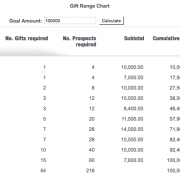
Here are the steps you can take to develop your prospect master list:

  • Use informal organizational networks including organizational friends and family members i.e. Board members, staff, volunteers, etc. to identify prospects within their respective networks who have both wealth and affinity for the cause.
  • Ask your current donors when meeting with them if they know of anyone else who may support the cause.
  • Research prominent donors to other similar organizations who may be making small gifts to your organizations. It is helpful to obtain copies of their annual reports, newsletters, and even event programs to see the giving levels of the prospective donors. Annual reports may be found online or hard copy by request.
  • Research who has been attending your events. There are folks here who already know of your mission and may be willing to deepen their relationship with you.
  • Research others who live in your community who might give to you using voter, property (Grand), the local chamber of commerce, houses of worship, and other lists.

So now what do you do when you have all this information?

Here is what I recommend:

Cull through all these lists to create a Master List of prospects whom you think “make the cut” regarding any possibility of capacity, affinity, or connection.r

Let me define these for you.

  • Capacity – ability to give
  • Affinity – philanthropic to a similar cause or interest
  • Connection – involvement in your organization

Once you have this Master List developed then work with the fundraising/development committee, Board of Directors, or other volunteers (they should know folks in the community) to rate and rank each donor during a rating session to determine potential giving capacity, interest, and affinity.

Then, organize lists of donors into tiers of giving to decide who is approachable first, those needing further cultivation, etc.  I just happen to like this worksheet right here!

And, from there you have a Master List of the top 20-25 prospective donors to your organization.  Even the smallest of non-profit organizations should be able to come up with a Master List of at least 25 potential donors after following these steps.

And, if you need someone to help build your prospect list for your next fundraising campaign, Development Consulting Solutions is always here for YOU!


April 15, 2017/0 Comments/by hireacfre
Blog, Campaigns, Capital Campaigns, Direct mail, Grant Writing, Individual Giving, Major gifts, Online, Planned Giving, Planning, Resources for the professional, Small shop fundraising

How a gift range chart can help you raise more money even in your small nonprofit

One might think that gift range charts are just for large projects such as capital campaigns or for significant fundraising efforts.  And, while, yes, there is some truth to that, gift range charts can be used effectively in even the smallest of fundraising shops.

A gift range chart will tell you exactly how many gifts AND prospects you need at each giving level to reach your goal. And, it also shows you the potential to reach your fundraising goal.

So, first, how do you create one?

  • Well, you can use any online calculator to do so.  I highly recommend the simple and easy to use Blackbaud gift range calculator.  You can find that tool here.
  • A gift range chart calculator is only going to provide you with an estimate. If you want to be more accurate, you may want to create the chart on your own using the given realities of your organization.  So, how do you go about creating your own?  Well, you will want to identify the highest level gift to your fundraising efforts.  That will probably be somewhere in the area of 20% of goal.  Estimate 3-5 prospective donors per gift.  Fill in your chart downwards based on what you know about your donors and their capacity.  Gift amounts go down, and the number of donors increases.

So, here is what a $100,000 fundraising goal would look like: https://www.blackbaud.com/nonprofit-resources/gift-range-calculator

How do you now use this information to inform your strategy?

  1. I would first look at the top gifts needed.  Here in this example, you would need 1 – $10K, 1 – 7.5K, 2 – $5K, and 3 – $3.5K for a total of $38K.  There are several options, right? You could write several grants.  In this case, you would need 28 grant possibilities, or you could approach a few major donors.
  2. Then if you look at your next tier of gifts, you would need $34K in gifts.  Perhaps you have a fundraising event, or maybe a direct mail campaign or a series of direct mail campaigns.  Or perhaps you continue to ask for gifts at this level.
  3. Maybe you look even further down and realize that you have a series of direct mail appeals, or that one appeal will do it for the remainder of the $28K or so.

The fact of the matter is that any possibility of a strategy will work, as long as it is realistic and fits for your organization. The key thing to remember is that you want to secure the top gifts first.  If you don’t raise those, then you need to readjust all the lower levels of the gift range chart below to “make up” for the difference.

Then, you can use this gift range chart as a monitoring and reporting tool. Let’s say that you are not hitting your “lead” gift targets.  Well, you can certainly adjust this gift range chart mid-course and make the necessary adjustments to your strategy BEFORE your fundraising efforts get too far off track.  And, this would be a great tool to share with your Board of Directors to educate them on the process of raising money and how your particular efforts are progressing towards projections.

So, though you may think that gift range charts are for the “big shops,” think again, a gift range chart can provide even the smallest campaign with focus and goals based on actualities and realities.

So, this next fiscal year why don’t you first start by creating a realistic gift range chart for your annual fund campaign and develop strategies to get you to your goal.


SaveSave

SaveSave

SaveSave

April 9, 2017/0 Comments/by hireacfre
Blog, Board development, Planning, Resources for the professional, Small shop fundraising

Is it time to close our nonprofit doors?

As a nonprofit organization, you are here to meet a mission to your stakeholders.  Maybe long ago, or not so long ago, you were founded to assist a particular group or meet a critical need.  And, months go by, years go by, and you are still in existence.  But, is the need still there?  Are you still relevant towards meeting that need?

Sometimes, we just don’t want to answer this question.  Because in answering it, you may find, that yes, indeed, you have met your mission or, in fact, are no longer relevant, or facing a crisis, or maybe even just plain exhausted and lack energy as an organization.

Is it time to dissolve perhaps?  Maybe merge with a similar group?  Shutting down is not the only option, but it is one.

Let’s face it, was it ever our intent to be here forever?

Hopefully not.

In admitting that you have met your mission, you have done exactly what you have set out to do.  And, more and more nonprofits are choosing this route, admirably I may add.

Ultimately, though, this is a larger Board discussion.

Why?

Because the Board of Directors is directly responsible for the organization’s future:  whether to grow, change, downsize, merge, evolve, or close.  This is governance at its most important and highest level.

Here are some important questions to explore as a Board before you do:

  • Are we meeting our stated mission?
  • Are we helping our intended audience?
  • Are we still relevant to our community?
  • What is the situation that is precipitating this discussion?  Are we tired, lack energy?  Financial constraints?  No longer needed?
  • What would be the implications if we did no longer exist?
  • Do we want to continue?  Can the organization be saved?
  • Have we simply run out of steam and need to close down?
  • Is it time to let us fail instead of always trying to “right” the ship?
  • Do we have adequate human resources to keep things going and are they the right people?

After seriously reflecting on these questions, a nonprofit Board can choose to take several routes.

  • You can choose to change your mission statement to reflect who you are and what need you are truly meeting.
  • You can choose to restructure your operations, programs, and activities to lead to a better functioning organization.
  • You can find a similar nonprofit organization in mission and merge.
  • If under undue financial stress, you may consider filing for bankruptcy
  • Or, if you are just tired or having met your mission, you can cease to operate and dissolve.

Ultimately, the Board must recognize that a crisis situation exists, focus efforts on addressing this issue, and come to a consensus-based conclusion on which path is most appropriate to your mission, to the community you serve, and to yourselves as individual Board members.


March 25, 2017/0 Comments/by hireacfre
Blog, Campaigns, Capital Campaigns, Donor relations, Individual Giving, Major gifts, Planned Giving

What’s next after your capital campaign feasibility study?

So, your consultant has just finished your capital campaign feasibility study.  The report is sitting on your desk, and you are wondering, where do I go from here?

Here are some possibilities:

The report may recommend that the organization takes some time to prepare its fundraising infrastructure before going into full campaign mode. Preparation may include things such as strengthening volunteer leadership, identifying campaign chairs, enhancing their fund development office, etc.  The organization should take the time to heed these recommendations and work either internally or with the/a consultant to strengthen some of the key identified areas before mounting a full capital campaign effort.

In some cases, the report may recommend that the organization move into full capital campaign mode.  In that case, the agency should seek to hire outside counsel either the firm that conducted the feasibility study process or another fundraising firm specializing in capital campaign management.

This report should be presented to the Feasibility Study Committee for review and once accepted by this committee; the committee should then give the report to the organization’s full Board of Directors for approval.  Once the Board approves, it should move to act on the recommendation found in the study.

In no shape or form, should this study be allowed to slip away or be placed on a shelf somewhere.  Time for action is now.  You do not want to lose the interest of donors and other key community members who have been part of the process and in some senses cultivated for a capital campaign effort.

In fact, the organization should share an abbreviated format of the study with these key donors and community members, and seek their opinions and possible engagement in the findings and campaign next steps.  The worst thing that can happen is that momentum is built through the study process and then grinds to a halt.

Accept the report, begin recommendation implementation, and engage key stakeholders throughout the process.

March 18, 2017/0 Comments/by hireacfre
Blog, Campaigns, Donor relations, Major gifts, Planned Giving, Planning, Resources for the professional, Small shop fundraising

Donor cultivation and stewardship – it’s all unique and one-of-a-kind!

I often get asked from my clients, how many touchpoints do you need to give to a donor at a certain level?

And, my answer – it varies.

There is some science to the whole matter.  In fact, after I conduct a rating and ranking session, I will combine all of the numbers and come up with a formulaic cultivation quotient.  The number of touches estimated for a particular donor’s rating score and ranking.

To me, that is a guide.  What we must remember is that each donor is an individual.  They have different motivations for giving, different ways that they would like to be recognized, and different things that they are interested in giving to support. And, that means that they all have different cultivation and stewardship needs as well.  So, while I could say that the cultivation quotient for Mrs. Smith came out to 20 touches per year, she may not want to be contacted or that involved with the organization.

I advocate that each necessitates a thorough review and a particular strategy custom and unique for them.  And, often, it takes a wise fundraiser who has been in conversation with the donor to recognize what is or is not important to them.

Now, I am not advocating that we throw the “moves management” system of relationship-building out.  However, what I am recommending instead is that we seriously advocate instead for a very donor-centered process that takes in the uniqueness of each donor into the “moves management” equation when developing strategies for cultivation and stewardship.  Let’s not reduce our donors down to formulas, quotients, or tactics.  They are people – unique and compassionate!

March 12, 2017/0 Comments/by hireacfre
Campaigns, Individual Giving, Major gifts, Planning, Resources for the professional, Small shop fundraising

More than just a monetary number – the capital campaign feasibility study

There are quite a number of groups seeking to test the feasibility of a possible capital campaign.

And, so naturally being a consulting firm catering to small fundraising shops, I tend to get asked to talk about these, and I am currently in the midst of one now.

What I find is that groups think that feasibility studies only test for one thing and that one thing is a financial goal.

I assert that there are many different types of things that a feasibility study tests for as a result.  Financial goals being just one.  In fact, more importantly, feasibility studies look at both internal and external perceptions and find areas of opportunities and challenges for an upcoming campaign.  Things such as “what about that large endowment the organization has?”  or “it doesn’t have strong fundraising leadership?” or “you need to ensure that so and so is on board and committed to launching a full-scale effort.”

Through a feasibility study, a group also finds out about potential campaign leadership, which by the way, can make or break a proposed capital campaign, other competing campaigns currently or just recently completed within the same community, and potential prospective donors to a capital campaign.  Also, a capital campaign feasibility study will unearth the general economic outlook both nationally and locally and how will that impact the success of a capital campaign.

So, as you can see, a feasibility study done correctly will provide lots of data that can then be used to refine the case for support, determine if it is time for the organization to mount a significant campaign, and what is the recommend campaign plan based upon findings as part of the study.  Oh, yes, and what fundraising goal will be feasible.

If you or your group is considering an upcoming capital campaign, I urge you NOT to skimp on the process of conducting a feasibility study.  You will learn more than just – can this campaign make a go of it.  You will find out exactly how much and how it can or cannot!

February 5, 2017/0 Comments/by hireacfre
Blog, Campaigns, Donor relations, Individual Giving, Major gifts, Planned Giving, Resources for the professional, Small shop fundraising

The revolving fundraising door at our organizations

What is going on out there?

For the past year, I have watched development jobs come and go on the job boards.

I lamented that folks like myself with over 20 years of experience, certifications, and education were getting passed up for the lower paid, less experienced, “greener” young ones.  And, there might be some thread of truth to that.  I can’t be all wet behind the ears.

But, the funny thing is lately, after a year of scanning job postings, I started to notice something very, very interesting.  The same postings were coming up.  A place down in Newport, a place in Dorchester, the same job, needing the same person.

It is so costly to keep having staff turnover.  Expensive in many ways.  Not just because of having to fill a vacancy, but costly to the organization as its donor base is disturbed.  Development is all about relationships, and if high staff turnover continues, those relationships are never truly built.

Another thing that I have noticed is that some organizations are being a bit more proactive.  Seeking out referrals for qualified candidates and then actively recruiting instead of waiting for candidates to apply and come to them.

The smarter move, I might add.

I guess I pen this manifesto for all those development professionals who have spent years in the field honing best practices and in some cases even developing them.  It is time that organizations stop looking for the cheapest, youngest, idealistic help.  It doesn’t serve the organization to cut the budget by hiring inexperienced newbies for its top position, particularly when it comes to fund development.  Can you afford to take a chance on someone who is “green” behind the ears to figure it out as they go along?

I think naught!  If you think differently, leave me a comment below.


January 28, 2017/1 Comment/by hireacfre
Blog, Campaigns, Direct mail, Donor relations, Grant Writing, Individual Giving, Major gifts, Online, Planned Giving, Planning, Resources for the professional, Small shop fundraising

New “DCS” interim development services

Development Consulting Solutions is announcing NEW interim and project-based service offerings:

Who is “DCS”?
There are limited Certified Fund-Raising Executives (CFRE) providing outsourced fund development services and serving as interim fund development staffing. What most organizations need is someone who can do the work for them!

“DCS” recognizes this need and has provided this service to a variety of small to mid-sized nonprofits throughout the New England region. Some of these nonprofits have included Malta House of Norwalk, CT, Friends of Buttonwood Park of New Bedford, MA, and United Methodist Elder Care of East Providence, RI.

“DCS’s mission”
“DCS” does not engage with everyone! We have a rigorous eligibility requirement and screening process and only work with four select clients at a time.

What are our requirements? We only work with small to mid-sized organizations that are ready, receptive, and willing to take their development program to the next level through outsourced assistance. These organizations have an engaged Board of Directors, an open-minded and willing staff, and leadership ready to support the organization.

We only work with organizations that are willing to invest in their development function, value established service costs, heed professional advice, and strategy, and act respectfully in the client and consultant relationship.

By selecting those clients most ready to embark on taking their organization to the next level, “DCS” provides you with the tools and staffing to raise more money in support of mission!

Why “DCS?”

  • To provide outsourced development expertise to organizations that do not want to hire someone in-house.
  • To assist busy executive directors with taking a few things off their plates.
  • To reassure donors during a transition or vacancy in your development office that your fundraising efforts will continue
  • If time is needed to do a search for a permanent development director, and you do not want to be rushed to make a selection
  • When you are seeking a new executive director and you want to be sure that this leader has an opportunity to select the permanent development director
  • Because as interim development director, I can have more candid conversations with the executive director, board, and other leaders about why there are problems with keeping development staff or staff is underperforming
  • When your organization has never had a development director and needs an experienced professional with a proven track record to start up the development office and pave the way for a more junior development officer to be successful.

Here is what “DCS” can do for you:

  • Assess current fundraising activities and make recommendations to improve strategy
  • Improve your fundraising efforts
  • Model what a good development officer does
  • Enhance systems and processes within the development office
  • Troubleshoot development problems
  • Coach the Executive Director and Board in fundraising to boost confidence and skill
  • Help with the hire of a permanent development director

“DCS” helps with:

  • Major Gifts
  • Direct Mail Appeals
  • Development print publications – your newsletter, annual report, brochures, etc.
  • E-Appeals and E-Newsletters
  • Grants
  • Cultivation and Stewardship Events
  • Special Events
  • Capital Campaigns

For “DCS” pricing, please check out our menu of packages here!

January 15, 2017/0 Comments/by hireacfre
Page 2 of 7‹1234›»

Like DCS on Facebook

Latest Posts

  • 5 Tips for Converting Crowdfunders to Lifetime DonorsMarch 24, 2022 - 2:06 am
  • Here’s the Checklist You Need to Create a Communications Plan for your Nonprofit’s Next Fundraising Campaign!Here’s the Checklist You Need to Create a Communications Plan for your Nonprofit’s Next Fundraising Campaign!March 11, 2022 - 1:53 am
  • Social Media for Nonprofits: A Brief Guide to Boosting Your Year-End Fundraising Revenues through Social Media6 Ways to Use Social Media to Boost Your Calendar Year-End Fundraising RevenuesOctober 29, 2021 - 11:53 am
  • What Data Should You Leverage From Your Donation Form?October 14, 2021 - 9:15 am

Newsletter

Fill out this form to sign up for our email newsletter

Contact

Development Consulting Solutions
New Bedford, MA
(508) 685-8899
[email protected]
Join Our Community

idda-linkedin-badge

Schedule Free Session

Schedule your first 30-minute complimentary session to see if we are a great fit!

Book Now

Quick Links

  • Visit us on Facebook
  • Visit us on X
  • Visit us on LinkedIn

Join our Newsletter

Fill out this form to sign up for our email newsletter

© Copyright - Development Consulting Solutions | Privacy Policy
  • Twitter
  • Facebook
  • LinkedIn
Scroll to top