• Twitter
  • Facebook
  • LinkedIn
  • Contact us
  • My Account
  • Cart
  • Checkout
  • 0Shopping Cart
DCS Robin L. Cabral, MA, CFRE | Hire a Fundraiser
  • About Robin
  • Products
    • Webinars
  • Resources
    • Blog
      • Board development
      • Campaigns
      • Donor relations
      • Grant Writing
      • Individual Giving
      • Major gifts
      • Online
      • Planning
      • Small shop fundraising
    • Subscribe to Newsletter
    • Videos
  • Speaking
    • Topics
    • Testimonials
  • Community
  • Services
    • Coaching with Robin L. Cabral, MA CFRE, MFIA
    • Consulting
    • Hire a Grant Writer
    • Hire a Fundraiser
    • Speaking topics
    • Clients
    • Testimonials
  • Australia Office Services
    • Visit our Australian website
  • Search
  • Menu Menu

Posts

Blog, Campaigns, Donor relations, Individual Giving, Online, Resources for the professional, Small shop fundraising, Special Events

How to raise more money this Giving Tuesday

Giving Tuesday, the Global Day of Philanthropy is on Tuesday, November 28.  The Bill and Melinda Gates Foundation is partnering with Facebook again this year to provide a  match up to $2 million to donors who give during that day.

Here are the specifics of this match:

Donations made to participating nonprofit organizations through Facebook’s charitable giving tools beginning at 8:00 am EST on November 28 will be matched — up to $50,000 per nonprofit, or $1,000 per fundraiser or donate button — until the matching funds run out. Facebook and the Gates Foundation are contributing $1 million each for the campaign, and all matched funds will be paid out to nonprofits through Network for Good’s donor-advised fund.

So, what can your organization do to prepare?

Here are some simple steps that I have been recommending to nonprofits to take advantage of this match:

1 – Determine what your Giving Tuesday monetary and non-monetary goals are.  How much do you want to raise?  How many new donors do you want to attract?

2 – Ensure that you have activated your Facebook “Donate” button first and foremost.  Ensure that you are using Facebook’s full scope of charitable giving tools. Otherwise, you will not be eligible for the match.  You also want to ensure that your pages are branded so that folks can recognize the Giving Tuesday campaign.

3 – Ensure that your website and online donation portal are up-to-speed and ready to go.  Make sure that you rigorously test them.  Your website and donation portal should be easy for a donor to use and navigate.  Donating should not be difficult.

4 – If you have work to do on your donor lists, now is the time.  Make sure that they all get uploaded into your Donor Management System, particularly your email addresses.

5 – Draft your social media and email messaging now.  You will want to announce this match opportunity in advance as well as send out reminders the day before, the day of, and an acknowledgement the day after.  Use key days such as “Black Friday” as messaging points.  Be sure to use photos, videos, and testimonials.  Consider integrating into your current calendar year-end campaign.

6 – Be sure to recruit ambassadors as social media messengers for your cause during this campaign.  You may want to enlist your Board, staff, and volunteers to help spread the word about your GIving Tuesday by sharing your social media messages with their family and friends.  If you are using Peer-to-Peer Fundraising, then get your folks set-up and engaged in advance of the actual day.

7 – Develop a plan to steward these Giving Tuesday donors once Giving Tuesday is complete, and you begin marching into December.

These are some simple steps that you can take to begin to plan for your Giving Tuesday campaign.

Now, I want to hear from you.  What steps is organization taking to prepare for this day of giving?

Post your thoughts in the comments below.
 

SaveSave

SaveSave

SaveSave

November 11, 2017/0 Comments/by hireacfre
Campaigns, Direct mail, Donor relations, Individual Giving, Major gifts, Planning, Resources for the professional, Small shop fundraising

How to have a direct mail appeal reply envelope that increases your appeal returns

When organizations create their direct mail appeal letters, the remittance envelope is often an afterthought.  Far too many organizations put little thought into how the envelope or reply device should appear and what it should say.  Many believe that a generic reply envelope will do just fine for their purposes or others want to “use up” their existing reply envelopes and what better way?

Well, time to start thinking otherwise.  Your direct mail appeal reply device can help boost your direct mail appeal returns.

If designed correctly, you can inspire donors giving sights and increase charitable income towards your mission.Below are a few simple steps to help you begin to segment your major donors and start to ask them more personally to support your calendar year-end appeal.

Below are a few simple steps to help you begin to segment your major donors and start to ask them more personally to support your calendar year-end appeal, just by making a few simple and easy tweaks.

1 – You want to be sure that your reply device mirrors the messaging of the direct mail appeal including using similar wording and themes.

2 – Ensure that even your reply device includes your mission statement and perhaps even a donor impact statement.  One reply device that I created for my client states “She had nowhere else to turn…but, you gave her hope and a home.”

3- I long ago advocated against the use of Business Reply Envelopes (BRE’s).  You know the ones where the organization pre-pays them up front and then uses them to entice donors to give.  Do you think saving money on a postage stamp is going to make all the difference in the world to a donor?  Not a big incentive.  Save your organization money and have the donor place the stamp.

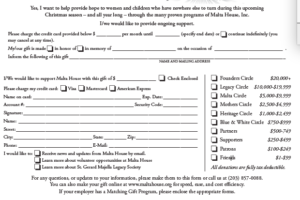
4- Include monthly/quarterly or any recurring donation option on your form by simply stating, “I/we would like to provide ongoing support. Please charge my credit card $ _________ per month until ________.”  Or even better “continue indefinitely.”

5 – Include a section where donors can make gifts “In honor of/In memory of…”

6 – Ensure that all email captures are “permission-based.”  If you have a line to capture email addresses and you plan on sending out newsletters or updates, be sure that you ask the donor permission.  Consider having a check-off box that states something like, “Yes, I would like to receive periodic updates from the organization.”

7 – Consider having a check-off box to encourage volunteering, i.e., “I would like to learn more about volunteer opportunities at the organization.”

8 – Surely, have a check-off box where folks can indicate interest in making a planned gift to the organization and a separate one noting employer matching fit programs.

9 – Always have contact information on your reply device.  If donors have specific questions, they need to know whom to contact, and your job is to make it easy and simple for them.

10 – You may also want to consider adding gift strings.  Don’t leave the giving up to the inevitable “other” giving category.  If you can do personalized gift strings, at least have suggested amounts that mirror the copy of your direct mail appeal letter.

So there you have the simple steps that you can immediately take to supercharge your reply envelope and increase your direct mail appeal returns to your calendar year-end campaign.

These are the same steps that I ensure I use when I create my client’s direct mail appeal package. And, they work!

For more simple steps that you can immediately take to enhance your calendar year-end appeal to support your charitable mission, feel free to contact me and schedule a 15-minute consult to discuss your specific campaign.

Join me for a FREE webinar on Thursday, November 16 at 1 p.m. on “How to Develop a Gift Range Chart and Customized Gift Strings to Maximize Your Year-End Giving Efforts.” – Don’t delay register today! Registration limited to the first 100 registrants.

SaveSave

SaveSave

November 4, 2017/0 Comments/by hireacfre
Campaigns, Direct mail, Donor relations, Individual Giving, Major gifts, Online, Planning, Resources for the professional, Small shop fundraising

How to segment and personalize your year-end fundraising campaign

It is year-end campaign planning time.

Far too often I see organizations using a blanket approach with their donor base. With a few minor tweaks in their strategy, they can increase their revenues by a third, sometimes even double.

What strategies do I recommend?

Well, what I often see is that one of the most overlooked areas of planning in small to mid-sized nonprofits is segmentation and personalization of their campaigns.

What do I mean, don’t send everyone the same letter for starters.

Let me share with you steps on how to segment and then personalize your year-end fundraising efforts.

1 – Start by determining all of your different donor segments and audiences. For instance, you may have Board members, Honorary Trustees, major donors, planned giving donors, monthly donors, lapsed donors, LYBUNTS, loyal and consistent donors, staff, volunteers, etc.

2 – Once you have your “buckets” of possible segmented donors, then begin to think about your various approaches to them. For instance, with major donors “hold” their letters, and instead engage the Board of Directors in making personal visits and calls.  Also, have designated staff members conduct an in-house campaign.

3 – Once you have determined your specific strategies for segments, you will move to creating your actual solicitation approaches. For personal and telephone solicitations, you may need a “pre-call” letter and a packet of collateral materials with the letter prepared.

4 – For the bulk of your segments, you will probably be utilizing some form of direct mail appeal. Do NOT use a “Dear Friend” letter. In today’s age, mail merging even in office is easy and simple to do.

5.  I do NOT recommend using a generic, blanket letter approach.  Instead, you want to custom tailor a letter for each segment identified.  What do I mean?  Well, in most cases, you are not going to create an entirely new letter for each segment.  What I recommend you do is creating a paragraph or two of custom-tailored text that you will insert into a “base” letter.  You may have loyal and consistent donors who have been giving to you for multiple years. In this case, you may have a paragraph front and center that thanks them for all their past support of the organization.   For a sample of segments and custom tailored text, email me!  

6 – You may also personalize gift strings.  Personalizing gift stings helps to upgrade donors to a higher giving level.  There are many formulas to use, but pick one and be consistent.

7 – Once you custom tailor the letter and the gift strings, then you need to determine if you will use a “lift” note or write personal notes right on the letters themselves and to what segments of donors are you using this technique.

8 – Determine how you are going to mail these letters.  Major donors you may want to consider sending a personalized letter with a first-class stamp.  Other donors you may want to use a non-profit pre-cancelled stamp or bulk mail indicia.

9. All of these techniques can be done for your online audiences as well.  You can custom tailor segments in your email marketing provider program, create separate emails, and email out to them. Don’t forget when doing second or third emails to filter out all those who have given by using a dynamic filter.

So there you have the simple steps that you can immediately take to enhance your year-end fundraising campaign to inspire your donor’s sights to support your charitable mission.

These are the same steps that I use when designing and implementing my client’s year-end fundraising campaign. And, they work!

For more simple steps that you can immediately take to enhance your year-end fundraising campaign to inspire your donor’s sights to support your charitable mission, feel free to contact me and schedule a 15-minute consult to discuss your specific campaign.

For a FREE sample template of personalized segments and custom tailored text, email me.  

SaveSave

SaveSave

SaveSave

SaveSave

SaveSave

August 12, 2017/0 Comments/by hireacfre
Blog, Direct mail, Donor relations, Individual Giving, Major gifts, Online, Resources for the professional, Small shop fundraising

How to re-engage lapsed donors in your organization

A lapsed donor is one who has lapsed from giving at least a calendar year.  They are the most significant donors to focus your efforts on re-engaging since they have already demonstrated an interest in your organization.

There are several ways to re-engage these lapsed donors.  Here are some suggestions that you can implement within your organization.

  1. Identify those donors who gave last year and yet have to donate this year.  Those are your lapsed donors.
  2. Add up the total giving from these lapsed donors.  Surely after seeing this number, you will want to spend some time trying to recapture them.
  3. Segment out the major donors from this list.  A major donor giving level will vary from organization to organization i.e. $250, $500, $1,000, or even more.
  4. Share this list with your Development Committee of the Board and discuss the plan of action.
  5. Have Board members identify those major donors that they can personally call on.
  6. Intend to call on these donors either through personal visits or telephone to secure a gift commitment.
  7. Plan to send a specialized segmented direct mail letter to all others not identified as major donors.

You could also use this same strategy for each appeal that you send out to be proactively trying to prevent lapsing from occurring in the first place.

For more a strategy on how to do this, visit this link here.  And, for a sample copy of a lapsing donor direct mail appeal letter, email me here.

SaveSave

SaveSave

SaveSave

July 22, 2017/0 Comments/by hireacfre
Blog, Campaigns, Capital Campaigns, Donor relations, Individual Giving, Major gifts, Planning, Resources for the professional, Small shop fundraising

How to create donor recognition opportunities for your fundraising campaign

An important part of any fundraising campaign is how you plan on recognizing your donors at different giving levels. While donor recognition opportunities do not motivate all donors, the fact is that some are. And, you need to be prepared to offer this valuable tool to inspire the sights of your donors who are motivated by public forms of recognition. Different things motivate different donors. So, always begin by knowing your donor.

Below I share with you a step-by-step method to creating Donor Recognition Opportunities that will inspire your donors to set their sights higher. And, public recognition inspires all donors from big to small and for all kinds of fundraising campaigns, not just capital ones.

There are several important guidelines that one should consider first before actually coming up with the recognition opportunities.

First, it is important that you have several recognition opportunities available for your donors to select.

Second, the top-level gift should be larger than the largest gift projected during the fundraising campaign.

Third, the cumulative values of the donor recognition opportunities should add up to significantly greater than the overall fundraising goal.

And, lastly, the donor recognition opportunity should be two to three times the costs of construction, furnishings, or overall costs of the opportunity.

Once you have given these guidelines consideration, here is how you can establish your donor recognition opportunities step-by-step.

Step #1 – Invite key staff and volunteers to a Donor Recognition Planning Meeting and review your building plans or fundraising campaign outline.

Step #2 – Brainstorm all of the possible named gift opportunity “places” or “things” i.e. main lobby, flag pole, endowed department, scholarships, staff positions, etc. Think expansively and creatively remembering that nothing is off limits.

Step #3 – Write each possible brainstormed building place on a sticky note and put them on the wall in random order.

Step #4 – Look at your campaign gift range chart and determine how many gifts are needed at each level to reach your goal.

Step #5 – Determine the “Curb Appeal” gifts. These gifts are those that provide value for the opportunity and are not necessarily just based on gift size. For instance, a lobby will hold more “curb appeal” than say a large industrial kitchen located in the back of a facility hardly ever seen by the general public.

Step #6 – Match the top “Curb Appeal” gift with naming opportunity that is the largest on the list, etc.

Step #7 – Be sure to present this Donor Recognition Plan to the Board to ensure that they approve of your plans. Ensure that the Board votes to approve this plan. Don’t skip over this step! You need the Board’s support.

There are also other ways that you can recognize your donors. For instance, you can recognize mid-level to lower-level givers with a group plaque, listing in the print donor honor roll, or on the organization’s website. You may also choose to run brick and pavers or wall tile program. And, inevitably, you will recognize all of your donors at a post-campaign celebratory event.

If you would like to see a sample Donor Recognition Plan, email me!

One thing that you do need to ensure is that you are consistent with how you recognize your donors. Everyone needs to be treated equally regarding what his or her gift will afford in a named gift opportunity.

And, now the organization is ready to begin asking for gifts from donors using these different named gift opportunities as a way to motivate donors to step up their giving to the campaign.

And, if you need help developing your fundraising campaign donor recognition opportunities, let us help you! 

SaveSave

SaveSave

June 10, 2017/0 Comments/by hireacfre
Blog, Campaigns, Direct mail, Donor relations, Individual Giving, Resources for the professional, Small shop fundraising, Uncategorized

How your direct mail appeal letter typesetting can help your letter raise more money

One may think that the content or copy of a direct mail appeal letter is King (or Queen), but studies have found that there is something else as equally or maybe even more important than what the letter says.

What is that one thing?

Typesetting.  And, typesetting does matter when it comes to direct mail appeal letters.

Typesetting refers to how one presents information on a page.  Eye-motion studies have found that readers don’t read word for word all that is on the page.  Reader’s eyes are drawn and attracted to what is on the page through the strategic use of photos and captions, liberal uses of white space, and formatting emphasis such as bolding, underlining, and italicizing.  Today, this is becoming more of the case as we rely on social media such as Facebook and Twitter for 140 characters and snippets of information.

Here are some of my top tips to help your direct mail appeal be the best that it can be.

  1. Readers skim. So, photos with captions (and a caption that points out how the donor is making a difference), and underlined and bolded text all help to keep the reader skimming and highlighting the key points you would like them to learn. Ensure that photos are of high quality and show faces, especially emotive eyes. People connect to one another, even on paper, with eyes.
  2. A two-page letter does test better than a one-page letter. Since donors are skimmers, repetition is essential. It may seem redundant to keep repeating things over and over, but, donors do not read all that your write. So, keep repeating your core message and “ask” throughout the body of the letter with again using formatting for emphasis.
  3. Keep letter format consistent regarding type size, font usage, etc. Anything that makes it difficult or confusing for the donor to read, decreases readability.
  4. Keep your paragraphs short and concise. The reader may lose their place, focus, and tend not to finish a story that they are in the process of reading if there is too large of a block of text.  And, you certainly do not want to have the reader miss important stories and other critical letter components.
  5. Make sure it is as easy as possible for the donor to give to you. Odds are they will not go too far out of their way should they wish to donate. Include the direct link to donate or make it as streamlined as possible.
  6. Lastly, don’t forget a P.S., invite the donor to speak with you directly, remind them that you are available for questions, or welcome their suggestions. Direct them to give online here. Just make it compelling with a direct ask, a deadline, and a call to action. Research shows that no matter what is in the body of the letter, the P.S. draws one’s eyes in.

So, though you may think that what you say is key, think again, a well-typeset letter has the power to get your letter read especially in this day and age of 140 characters of less.

For your next direct mail appeal letter, why don’t you take the six items listed above and incorporate them into your writing?  Doing these six things alone has the potential to significantly increasing the response rate of your letter.  And, don’t we all want letters that speak to our donors in ways that they will read them?

Email me here to get a sample of one of my very own direct mail appeal letters!

April 22, 2017/0 Comments/by hireacfre
Blog, Campaigns, Capital Campaigns, Direct mail, Grant Writing, Individual Giving, Major gifts, Online, Planned Giving, Planning, Resources for the professional, Small shop fundraising

How a gift range chart can help you raise more money even in your small nonprofit

One might think that gift range charts are just for large projects such as capital campaigns or for significant fundraising efforts.  And, while, yes, there is some truth to that, gift range charts can be used effectively in even the smallest of fundraising shops.

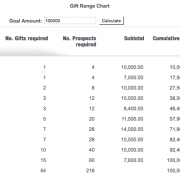
A gift range chart will tell you exactly how many gifts AND prospects you need at each giving level to reach your goal. And, it also shows you the potential to reach your fundraising goal.

So, first, how do you create one?

  • Well, you can use any online calculator to do so.  I highly recommend the simple and easy to use Blackbaud gift range calculator.  You can find that tool here.
  • A gift range chart calculator is only going to provide you with an estimate. If you want to be more accurate, you may want to create the chart on your own using the given realities of your organization.  So, how do you go about creating your own?  Well, you will want to identify the highest level gift to your fundraising efforts.  That will probably be somewhere in the area of 20% of goal.  Estimate 3-5 prospective donors per gift.  Fill in your chart downwards based on what you know about your donors and their capacity.  Gift amounts go down, and the number of donors increases.

So, here is what a $100,000 fundraising goal would look like: https://www.blackbaud.com/nonprofit-resources/gift-range-calculator

How do you now use this information to inform your strategy?

  1. I would first look at the top gifts needed.  Here in this example, you would need 1 – $10K, 1 – 7.5K, 2 – $5K, and 3 – $3.5K for a total of $38K.  There are several options, right? You could write several grants.  In this case, you would need 28 grant possibilities, or you could approach a few major donors.
  2. Then if you look at your next tier of gifts, you would need $34K in gifts.  Perhaps you have a fundraising event, or maybe a direct mail campaign or a series of direct mail campaigns.  Or perhaps you continue to ask for gifts at this level.
  3. Maybe you look even further down and realize that you have a series of direct mail appeals, or that one appeal will do it for the remainder of the $28K or so.

The fact of the matter is that any possibility of a strategy will work, as long as it is realistic and fits for your organization. The key thing to remember is that you want to secure the top gifts first.  If you don’t raise those, then you need to readjust all the lower levels of the gift range chart below to “make up” for the difference.

Then, you can use this gift range chart as a monitoring and reporting tool. Let’s say that you are not hitting your “lead” gift targets.  Well, you can certainly adjust this gift range chart mid-course and make the necessary adjustments to your strategy BEFORE your fundraising efforts get too far off track.  And, this would be a great tool to share with your Board of Directors to educate them on the process of raising money and how your particular efforts are progressing towards projections.

So, though you may think that gift range charts are for the “big shops,” think again, a gift range chart can provide even the smallest campaign with focus and goals based on actualities and realities.

So, this next fiscal year why don’t you first start by creating a realistic gift range chart for your annual fund campaign and develop strategies to get you to your goal.


SaveSave

SaveSave

SaveSave

April 9, 2017/0 Comments/by hireacfre
Blog, Campaigns, Direct mail, Donor relations, Individual Giving, Planning, Resources for the professional, Small shop fundraising

“Am I asking my donors too much?” Well, Virginia let me tell you the answer.

So, here it is. I am laying this question and answer right out on the line. Especially now that we are coming to the year-end giving season.

I am asked time and time again, “Didn’t we just mail to them, won’t we be bothering them?”

No, no, and no. You can never ask enough.

Yes, Virginia, you can ask multiple times

Let’s face it. The decision isn’t ours to make. It isn’t. It is the donor’s decision to make. Only they are going to tell you, how much is too much. In most cases, if you are only asking once or twice a year, aren’t you telling them that you don’t need the donations to make a go of it? Donors aren’t naive. They know that you are a non-profit, and they know that you need donations to run your organization. Why do we believe that we must lightly tread when it comes to asking?Direct Mail YES

Donors are busy people. Just because they didn’t respond to your initial mailing, doesn’t mean that they don’t want to give to support you. In major gift work, if we don’t get the gift right away during our meeting – and in most cases, we don’t – we explore with the donor the reason for hesitation. Was it the program we were asking for a contribution? Was it the ask amount itself? Was it the timing of the ask? Why do we think that this is any different for the number of times we should mail to a donor? Perhaps the reason that they didn’t respond to your initial mailing is that it wasn’t an ask for the right project or the right amount, or it wasn’t the right timing. Maybe they had a big bill just come in that they needed to tend to or perhaps they were on vacation when the letter arrived in your mailbox. But, we won’t know this if we only mail to them once and then assume the donor will never give again.

And, I often hear clients question whether or not they should include a reply envelope in their newsletter because they just sent out an “ask.” Of course, you put an envelope in your newsletter. This envelope is a “soft” ask. Donors may feel so inspired to give after reading about your good works in your newsletter that they may want to give to support your work. How else will you capture this? And, a “soft” ask is exactly that, “soft.” We are not commanding, directing, or cajoling a donor into giving. If they choose to give using this method, then it is their choice.

Case in point, I asked a client to send out a second direct mail ask to follow up on all those who did not give to the first. And, lo and behold, the response has been tremendous. So enormous, in fact, that the client wrote back and said, “The results have been pretty unbelievable for us, believe me!

I once had a phrase that I would use quite often, “You must A S K to G E T!” And, that is true.

As we move forward into the upcoming holiday giving season, think about your strategy. You will be competing with every other nonprofit group who is sending out their calendar year-end direct mail piece at the same time. The competition will be stiff. How are you going to stand out? How are you going to assure that your donors will read your letter among all of the other letters? And, what is your strategy for follow-up? Will you ask more than once? What forms will that “ask” take? How will you leverage the December 31 tax deadline as an incentive to give?

I know one thing is for sure, this calendar year-end, if you only ask once, you are doing your donors an injustice. They want to give, and they want to give to you. But, your ask must be heard and, that it is the right ask, for the right project, at the right time.

Now, craft a plan that includes multiple year-end asks!

October 23, 2016/0 Comments/by hireacfre
Blog, Donor relations, Individual Giving, Major gifts, Planned Giving, Small shop fundraising

Is your fear of asking causing you to make assumptions for your donors?

Let’s cut to the chase.  I know, and you know that one of the biggest things that stop us from being effective in our fundraising is fear.  Good old, heart pumping, nail biting, fear.

Recently, I had a conversation with some folks, and I asked them the question, “what is your number one concern around fundraising?”  And, time and time again, folks responded, “fear of being rejected.”Fear being rejected in your fundraising

Let’s face it; we just don’t like being told no.  And, while no may not be personal, it sure feels that way, right?

So, then I have had to ask, are we projecting onto our donors and making assumptions about how they will respond?  Meaning, are we projecting our fear of rejection onto them.  I am sure that we have all thought at some point, “Oh he won’t give anything to support us, so why even ask in the first place.”  Are we projecting our thoughts, fears, and assumptions on a donor, so that we won’t have to attempt to ask or even just develop a relationship with him or her?

There once was a very insightful book I read.  It was  Don Miguel Ruiz’s The Four Agreements.  He spends a whole chapter on “Making Assumptions.”  Here is a quote that I think will help you in your work with donors:

“The biggest assumption (in my opinion) is that we assume everyone sees the world and each circumstance the way WE do. We assume they think, feel, and even judge the way we do. This assumption sparks our internal fear of being ourselves around othersŠ we think they will judge, victimize or blame us; just as we do to ourselves. So before someone has the opportunity to accept or reject us, we have already rejected ourselves. The way to keep from making assumptions is to ask questions.”

I urge you to take a look at your fears before embarking on major gift work.  Are you fearful of rejection personally?  And, how is that fear allowing you to make assumptions for donors, just so that you won’t suffer the slings and arrows of rejection in the asking?

This question that I pose is a tough question to think about, but I am asking you to dig deep, not for me, for you, or even for your organization, but for all those in need that you can help by clearing away your fears and your assumptions.


P.S. – Are you ready to get started with your first large fundraising campaign?  And, you want it to be successful?  Get started with my FREE 7 Steps to a Majorly Successful Fundraising Campaign and use the same EXACT steps that I share with my clients.  Click here to download your FREE 7 Steps “Cheat Sheet” and start planning your fundraising campaign today.   I will share with you all the steps you need to be successful before launching your next campaign.

May 22, 2016/1 Comment/by hireacfre
Blog, Donor relations, Individual Giving, Major gifts, Planned Giving, Small shop fundraising

Is scarcity stopping you from asking for a major gift?

Do these phrases sound familiar to you?

“I never have enough money!”
“Money goes out faster than it comes in!”
“Money doesn’t grow on trees!”

How often have we heard these phrases growing up?  Well, if you were like me, probably a lot.  As a child, these were the Scarcity mindset in major giftsmessages that I subconsciously learned about money, and they helped to develop my now adult relationship with it.

Just this week, I led a workshop on asking for money.  As part of the icebreaker exercise, I asked attendees to share with me some of their greatest fears about fundraising.  And, fear after fear centered around scarcity.  In fact, many participants commented that they grew up hearing the very same phrases above.

Stop and think about what you believe about money.  Are your beliefs limiting you in your work?  Do you have a scarcity mindset?

Have you ever found yourself saying these types of things?

“There are only so many donors to go around!”
“Donors only have so much money to give!”
“We already asked our donors once this year; we can’t ask again!”

Are we placing our beliefs on our donors?  Are we making assumptions for our donors?  Are we self-sabotaging our work?  Are we limiting our role in the work that we do?  Are we focusing our efforts and time on things such as events that will take us out of the context of asking?

To be truly effective fundraisers, we all need to dig deep and look at our views and those beliefs of scarcity that may be holding you back.   Are they self-limiting and if so how can you work to create an abundance mindset?  We don’t want scarcity from preventing our life-changing work from happening both for our donors and for our missions. So, it is critical that you identify your mindset and work to change it.  Major gifts start with you.  Get that part of the relationship right first.

Break the scarcity mindset before you ask for a major gift.

May 15, 2016/0 Comments/by hireacfre
Blog, Campaigns, Direct mail, Donor relations, Grant Writing, Individual Giving, Major gifts, Online, Planned Giving, Planning, Small shop fundraising

Fundraising audits inside and out

The fundraising audit is a major step in fundraising planning.  When you think about planning, you think about where are we, where do we want to be, and how are we going to get there?

The fundraising audit helps you to determine, where are you.  And, it is probably the most important step of the entire planning process.  If you don’t know where you are today, how can you even plan for tomorrow?  And, it is What is a fundraising audit?important to not only look at internal things that will impact your fundraising success i.e. Board of Directors, etc., but it is also critical to examine external factors as well.  Some external things that may affect the success of fundraising include political factors (i.e. election time), economic (a down economy), sociocultural (changing demographics), and technology (changes in the web, social media, etc.).  Development audits also tend to examine others in the industry including nonprofits serving the same type of causes, similar sizes, potential collaborators, and other market factors).

Also, one can examine the feasibility of conducting a future large-scale campaign. Currently, I am conducting a development audit for a nonprofit organization, and as part of that review, I am asking initial capital campaign feasibility questions to determine if a proposed future capital campaign would be a success.

An audit is just that, a systematic attempt to gather tons of data, and then analyzing and synthesizing this data against professional best practices.  While it is best that an objective third party person conducts this process, it can also be accomplished by a new in-house development staff member who still has an objective “eye.”  It is also helpful to have someone who has their finger on the pulse regarding what is shifting and changing in the philanthropic landscape.

A development audit is also a great way to engage key stakeholders i.e. Board members, donors, etc. who may need more cultivation.  It is just as much about the product as it is about the process.

Insanity is creating a fundraising plan without first doing an audit.

Do you have a long-term strategic fund development plan?

April 3, 2016/0 Comments/by hireacfre
Blog, Campaigns, Direct mail, Individual Giving, Small shop fundraising

A Case Study: Donor Acquisition – It Does Work!

This week, I had a conversation with one of my very first clients. And, I wanted to share their success story. You see, too many groups don’t want to invest in donor acquisition because they know that they will lose money – in the short-term. Who intends to invest in that, particularly if you are only thinking of the organization’s short-term success.

Donor Acquisition is itWell, this group had a total of 700 names in their donor file. And, they were in serious trouble operating in crisis mode. Person after person told them that they should not invest in donor acquisition, but

really what choice did they have. They knew that their donor file was suffering from natural attrition, and if they didn’t do something, they might as well not do anything at all.

They bit the bullet and against all odds decided to invest in donor acquisition. They hired a professional list brokerage and donor acquisition company who then supplied recommendations and advice on the records that best met their needs and premiums well suited to and representing their mission. Lists are usually anywhere from around $80 to $150 per thousand names and addresses for a single use. They also invested heavily in the acquisition renewal process, so that these first-time donors, would give again through a very intensive mail series. And, in fact, for the first seven donor acquisition pieces that they sent they did lose money. But, then the tide turned, just like it should with donor acquisition, and they began to see positive returns. And, not just with donor renewals, but with the acquisition mailing itself.

Now, several years later, they make money with their donor acquisition efforts. In fact, they are seeing donors who are sending in substantial donations as a result. In fact, they have received donations from donors renewing at $25,000 or more.

Further, they recently sent an urgent appeal to their donors in need of upgrading their sprinkler system. The result of this appeal mailing – net over $100,000.

So, when they started back in 2011, they had a donor list that had no more than 700 names. Today, that list has grown to well over 40,000 names.

Do you think that donor acquisition is way too costly for your organization? For this one small organization, it was, but if they wanted to be around, they had no other choice. While you may think that you cannot afford to invest in donor acquisition, imagine what could be achieved for your mission if you had a donor file that increased by over 5,500 percent in five years time!!!  How long has your donor file remained at the same stagnant number?

Donor Acquisition is THAT important to consider, and I know that you don’t want to, but to move your organization forward, you must. Your data file is declining just by merely being. What are you going to do about it?

More on donor acquisition in future blog articles.

February 7, 2016/2 Comments/by hireacfre
Page 1 of 212

Like DCS on Facebook

Latest Posts

  • 5 Tips for Converting Crowdfunders to Lifetime DonorsMarch 24, 2022 - 2:06 am
  • Here’s the Checklist You Need to Create a Communications Plan for your Nonprofit’s Next Fundraising Campaign!Here’s the Checklist You Need to Create a Communications Plan for your Nonprofit’s Next Fundraising Campaign!March 11, 2022 - 1:53 am
  • Social Media for Nonprofits: A Brief Guide to Boosting Your Year-End Fundraising Revenues through Social Media6 Ways to Use Social Media to Boost Your Calendar Year-End Fundraising RevenuesOctober 29, 2021 - 11:53 am
  • What Data Should You Leverage From Your Donation Form?October 14, 2021 - 9:15 am

Newsletter

Fill out this form to sign up for our email newsletter

Contact

Development Consulting Solutions
New Bedford, MA
(508) 685-8899
[email protected]
Join Our Community

idda-linkedin-badge

Schedule Free Session

Schedule your first 30-minute complimentary session to see if we are a great fit!

Book Now

Quick Links

  • Visit us on Facebook
  • Visit us on X
  • Visit us on LinkedIn

Join our Newsletter

Fill out this form to sign up for our email newsletter

© Copyright - Development Consulting Solutions | Privacy Policy
  • Twitter
  • Facebook
  • LinkedIn
Scroll to top