• Twitter
  • Facebook
  • LinkedIn
  • Contact us
  • My Account
  • Cart
  • Checkout
  • 0Shopping Cart
DCS Robin L. Cabral, MA, CFRE | Hire a Fundraiser
  • About Robin
  • Products
    • Webinars
  • Resources
    • Blog
      • Board development
      • Campaigns
      • Donor relations
      • Grant Writing
      • Individual Giving
      • Major gifts
      • Online
      • Planning
      • Small shop fundraising
    • Subscribe to Newsletter
    • Videos
  • Speaking
    • Topics
    • Testimonials
  • Community
  • Services
    • Coaching with Robin L. Cabral, MA CFRE, MFIA
    • Consulting
    • Hire a Grant Writer
    • Hire a Fundraiser
    • Speaking topics
    • Clients
    • Testimonials
  • Australia Office Services
    • Visit our Australian website
  • Search
  • Menu Menu

Posts

Blog, Campaigns, Capital Campaigns, Direct mail, Grant Writing, Individual Giving, Major gifts, Online, Planned Giving, Planning, Resources for the professional, Small shop fundraising

How a gift range chart can help you raise more money even in your small nonprofit

One might think that gift range charts are just for large projects such as capital campaigns or for significant fundraising efforts.  And, while, yes, there is some truth to that, gift range charts can be used effectively in even the smallest of fundraising shops.

A gift range chart will tell you exactly how many gifts AND prospects you need at each giving level to reach your goal. And, it also shows you the potential to reach your fundraising goal.

So, first, how do you create one?

  • Well, you can use any online calculator to do so.  I highly recommend the simple and easy to use Blackbaud gift range calculator.  You can find that tool here.
  • A gift range chart calculator is only going to provide you with an estimate. If you want to be more accurate, you may want to create the chart on your own using the given realities of your organization.  So, how do you go about creating your own?  Well, you will want to identify the highest level gift to your fundraising efforts.  That will probably be somewhere in the area of 20% of goal.  Estimate 3-5 prospective donors per gift.  Fill in your chart downwards based on what you know about your donors and their capacity.  Gift amounts go down, and the number of donors increases.

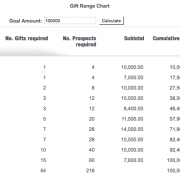
So, here is what a $100,000 fundraising goal would look like: https://www.blackbaud.com/nonprofit-resources/gift-range-calculator
How do you now use this information to inform your strategy?

  1. I would first look at the top gifts needed.  Here in this example, you would need 1 – $10K, 1 – 7.5K, 2 – $5K, and 3 – $3.5K for a total of $38K.  There are several options, right? You could write several grants.  In this case, you would need 28 grant possibilities, or you could approach a few major donors.
  2. Then if you look at your next tier of gifts, you would need $34K in gifts.  Perhaps you have a fundraising event, or maybe a direct mail campaign or a series of direct mail campaigns.  Or perhaps you continue to ask for gifts at this level.
  3. Maybe you look even further down and realize that you have a series of direct mail appeals, or that one appeal will do it for the remainder of the $28K or so.

The fact of the matter is that any possibility of a strategy will work, as long as it is realistic and fits for your organization. The key thing to remember is that you want to secure the top gifts first.  If you don’t raise those, then you need to readjust all the lower levels of the gift range chart below to “make up” for the difference.

Then, you can use this gift range chart as a monitoring and reporting tool. Let’s say that you are not hitting your “lead” gift targets.  Well, you can certainly adjust this gift range chart mid-course and make the necessary adjustments to your strategy BEFORE your fundraising efforts get too far off track.  And, this would be a great tool to share with your Board of Directors to educate them on the process of raising money and how your particular efforts are progressing towards projections.

So, though you may think that gift range charts are for the “big shops,” think again, a gift range chart can provide even the smallest campaign with focus and goals based on actualities and realities.

So, this next fiscal year why don’t you first start by creating a realistic gift range chart for your annual fund campaign and develop strategies to get you to your goal.


SaveSave

SaveSave

SaveSave

April 9, 2017/0 Comments/by hireacfre
Blog, Board development, Planning, Resources for the professional, Small shop fundraising

Is it time to close our nonprofit doors?

As a nonprofit organization, you are here to meet a mission to your stakeholders.  Maybe long ago, or not so long ago, you were founded to assist a particular group or meet a critical need.  And, months go by, years go by, and you are still in existence.  But, is the need still there?  Are you still relevant towards meeting that need?

Sometimes, we just don’t want to answer this question.  Because in answering it, you may find, that yes, indeed, you have met your mission or, in fact, are no longer relevant, or facing a crisis, or maybe even just plain exhausted and lack energy as an organization.

Is it time to dissolve perhaps?  Maybe merge with a similar group?  Shutting down is not the only option, but it is one.

Let’s face it, was it ever our intent to be here forever?

Hopefully not.

In admitting that you have met your mission, you have done exactly what you have set out to do.  And, more and more nonprofits are choosing this route, admirably I may add.

Ultimately, though, this is a larger Board discussion.

Why?

Because the Board of Directors is directly responsible for the organization’s future:  whether to grow, change, downsize, merge, evolve, or close.  This is governance at its most important and highest level.

Here are some important questions to explore as a Board before you do:

  • Are we meeting our stated mission?
  • Are we helping our intended audience?
  • Are we still relevant to our community?
  • What is the situation that is precipitating this discussion?  Are we tired, lack energy?  Financial constraints?  No longer needed?
  • What would be the implications if we did no longer exist?
  • Do we want to continue?  Can the organization be saved?
  • Have we simply run out of steam and need to close down?
  • Is it time to let us fail instead of always trying to “right” the ship?
  • Do we have adequate human resources to keep things going and are they the right people?

After seriously reflecting on these questions, a nonprofit Board can choose to take several routes.

  • You can choose to change your mission statement to reflect who you are and what need you are truly meeting.
  • You can choose to restructure your operations, programs, and activities to lead to a better functioning organization.
  • You can find a similar nonprofit organization in mission and merge.
  • If under undue financial stress, you may consider filing for bankruptcy
  • Or, if you are just tired or having met your mission, you can cease to operate and dissolve.

Ultimately, the Board must recognize that a crisis situation exists, focus efforts on addressing this issue, and come to a consensus-based conclusion on which path is most appropriate to your mission, to the community you serve, and to yourselves as individual Board members.


March 25, 2017/0 Comments/by hireacfre
Blog, Campaigns, Direct mail, Donor relations, Individual Giving, Major gifts, Online, Planning, Resources for the professional, Small shop fundraising

Oh, the woes of a nonprofit fundraising database!

So, let’s talk database.

What? That seems like something so mundane. Well, it may be, but it is so critical to fundraising.

Throughout my professional career, I have been victim to bad databases, and I have been asked to work with bad databases.

One thing is for sure, without an initial thought out structure, problems are inevitable. I often come into organizations that have no rhyme or reason as to what they call their Campaigns, Funds, and Approaches. You know, one year it is called Spring Appeal 2016, and the next it is labeled the Mother’s Day Appeal.

Consistency is key. I see so much inconsistency that why bother having a database, to begin with at all. The way names are entered i.e. Mr. and Mrs. Smith or Bob and Laura or even Robin and Smitty or Robin & Smitty.

It drives me mad.

Having a database procedural manual developed with consistent data entry standards specified is critical. How do you pass this institutional information along when staff transition or do you? Do you let them sink or swim?

Hey, garbage in is only garbage out.

The most important thing is the question of who has access to this database? Who does the main gift entry? Moreover, I pray that your answer is a development staff person. Please, do not say that it is a member of the finance department, or even worse, a volunteer or an intern.

Provide those using the database with training in the software itself and budget for it every year. Moreover, don’t think that a cost saving is ignoring software updates and the resulting costs.

I cannot stress enough how important the database is to your fundraising efforts. It will allow you to be donor-centered in your work regarding recognizing donors and their giving the exact way that they want to be recognized. It lets you accurately report on giving and make comparisons that will affect the future of your fundraising efforts, and it will allow you to become more strategic in your endeavors through segmentation and greater personalization.In all of my career if I had to answer the question of “What impacts the success of fundraising THE most, besides the Board, of course,” I would have to answer, the database.

Moreover, folks EXCEL is not a database; it is a spreadsheet tool used by those in the finance department. Please don’t say that you cannot afford a database. Some great databases are available for a very fair and affordable price.

Pay close attention to your database – this is the brain behind your efforts.


January 21, 2017/1 Comment/by hireacfre
Blog, Campaigns, Direct mail, Donor relations, Grant Writing, Individual Giving, Major gifts, Online, Planned Giving, Planning, Resources for the professional, Small shop fundraising

New “DCS” interim development services

Development Consulting Solutions is announcing NEW interim and project-based service offerings:

Who is “DCS”?
There are limited Certified Fund-Raising Executives (CFRE) providing outsourced fund development services and serving as interim fund development staffing. What most organizations need is someone who can do the work for them!

“DCS” recognizes this need and has provided this service to a variety of small to mid-sized nonprofits throughout the New England region. Some of these nonprofits have included Malta House of Norwalk, CT, Friends of Buttonwood Park of New Bedford, MA, and United Methodist Elder Care of East Providence, RI.

“DCS’s mission”
“DCS” does not engage with everyone! We have a rigorous eligibility requirement and screening process and only work with four select clients at a time.

What are our requirements? We only work with small to mid-sized organizations that are ready, receptive, and willing to take their development program to the next level through outsourced assistance. These organizations have an engaged Board of Directors, an open-minded and willing staff, and leadership ready to support the organization.

We only work with organizations that are willing to invest in their development function, value established service costs, heed professional advice, and strategy, and act respectfully in the client and consultant relationship.

By selecting those clients most ready to embark on taking their organization to the next level, “DCS” provides you with the tools and staffing to raise more money in support of mission!

Why “DCS?”

  • To provide outsourced development expertise to organizations that do not want to hire someone in-house.
  • To assist busy executive directors with taking a few things off their plates.
  • To reassure donors during a transition or vacancy in your development office that your fundraising efforts will continue
  • If time is needed to do a search for a permanent development director, and you do not want to be rushed to make a selection
  • When you are seeking a new executive director and you want to be sure that this leader has an opportunity to select the permanent development director
  • Because as interim development director, I can have more candid conversations with the executive director, board, and other leaders about why there are problems with keeping development staff or staff is underperforming
  • When your organization has never had a development director and needs an experienced professional with a proven track record to start up the development office and pave the way for a more junior development officer to be successful.

Here is what “DCS” can do for you:

  • Assess current fundraising activities and make recommendations to improve strategy
  • Improve your fundraising efforts
  • Model what a good development officer does
  • Enhance systems and processes within the development office
  • Troubleshoot development problems
  • Coach the Executive Director and Board in fundraising to boost confidence and skill
  • Help with the hire of a permanent development director

“DCS” helps with:

  • Major Gifts
  • Direct Mail Appeals
  • Development print publications – your newsletter, annual report, brochures, etc.
  • E-Appeals and E-Newsletters
  • Grants
  • Cultivation and Stewardship Events
  • Special Events
  • Capital Campaigns

For “DCS” pricing, please check out our menu of packages here!

January 15, 2017/0 Comments/by hireacfre
Campaigns, Individual Giving, Major gifts, Resources for the professional, Small shop fundraising

Is it time to go public with our campaign? Maybe, maybe not!

When to go public?

A question that I am asked a bit. When can our capital campaign go public? When can we put a thermometer out on our lawn? When can we start to ask our constituents and the general community? When can we have a special event and invite everyone?

The all important question, “is it time?”

My answer? Not until you have a certain number of lead gifts in hand. And, not before you have your institutional family committed to the campaign – folks like your Board of Directors, staff members, Campaign Steering Committee members, and your leadership donors.

Only when you have the majority of lead and family gifts in, is it time to broaden the focus and extend the solicitation process to more prospects through a more public campaign. Some say that you should have at least 50-70% of the entire gifts needed for the campaign in hand. But, one thing is for sure, the “Quiet” Phase is that indeed – quiet. There is no general advertising of the campaign or overall campaign fanfare.

Once you have a significant number of advanced gifts in hand, it is at this juncture that you should plan a campaign kickoff celebration event to aid in your project going “public.” This “public” phase is when the work of soliciting the organization’s broader constituency begins.

Then and only then should you put that “Community Thermometer” in the ground and start having your special shindig events.

So, is it time to go public – maybe or maybe not.  It all depends upon the science of campaigns and it is not something that you want to rush.

January 7, 2017/0 Comments/by hireacfre
Blog, Board development, Campaigns, Direct mail, Donor relations, Grant Writing, Individual Giving, Major gifts, Online, Planned Giving, Planning, Resources for the professional, Small shop fundraising

Do not take Fund Development best practices at face value!

Best practices. We hear that phrase often. This week, I even read a question asking if “best practices were misleading?”

Are we throwing that phrase around to legitimize our field? Our do we have best practices and what are they?Fundraising best practices

Well, I contend that the only true best practice is one that is grounded in research. Those are harder to find that than the other so-called “best practices.”

While studying for my Masters Degree in Philanthropy and Fund Development, I learned that philanthropic research has many gaps. However, there are people now making a study of philanthropy and conducting research. Folks like Adrian Sargeant and Jen Shang. More research is needed in our field to support our work.

I can tell you that when research is grounded in actual studies, it works. Eye motion studies, philanthropic psychology, etc., etc.

Recently, I have been working on many appeal letters. And, each time I craft one for the client, I get pushback. Why do you indent paragraphs? Why do you repeat yourself often? Why is there bold and underline? Do we need to include a P.S.? And, can’t the letter just fit on one page? Must we send more than one appeal?

Pushback that is unfounded. And, I push back with research. When the client allows me to use those best practices, the results speak for themselves.

When those results speak for themselves, it is magic. Campaigns get funded, new projects begin, and donors have the opportunity to make a greater impact.

We forget that the fact (and it is a fact) that we are not beggars. Donors want to give. And, to give, they must be asked. Asked in a way that moves them to feel connected to their core beliefs through your organization’s mission.

Know the difference between unfounded best practices and best practices backed by scientific research. Read blogs, stay current with trends, and keep furthering your informal and formal education. When you do, and you practice it, your results will show all the difference.

Fund development does have a researched body of knowledge. Don’t allow anyone to convince you that it does not.

December 3, 2016/0 Comments/by hireacfre
Blog, Board development, Campaigns, Individual Giving, Major gifts, Resources for the professional, Small shop fundraising

Yep, the Board does have a role in a capital campaign!

What, wait, we hired that Capital Campaign Consultant to run the campaign, and now you are telling me that I have to do something.  No, this can’t be possible.

Yep!  It would be unrealistic to think that a capital campaign is left up to the staff to manage.  How could they?  The staff doesn’t have access to donors and to peer networks?  A campaign is not a one, or two, or even three person job.  It is even more unrealistic to think that now the capital campaign consultant is in town, no one
needs to do anything period.

So, I know you’re shaking in fear that you might have to ask for money.  Well, yes, you may.  But, that is not your only role in a capital campaign.

When running a capital campaign, I meet with each of my campaign’s Board of Directors and review the Campaign Plan, goal, schedule, gift chart, and Case for Support.  I insist that they vote to approve these primary campaign documents.

And, I also share with them a Board commitment form that I have each and every one of them sign and date.

Board members have many responsibilities to a campaign. Below is my top ten list of capital campaign responsibilities and what I expect them to commit to:

  1. Not taking on any major new volunteer roles for other organizations and consider how to pare down current obligations and be accessible to the campaign.
  2. Review their philanthropic planning for the next year and perhaps beyond, as well as their calendars for those years.
  3. Consider what role they could and would like to play in the campaign. Every board member will be responsible for some part of the campaign and will be engaged in identifying and enlisting campaign committee members.
  4. Review their list of contacts – friends, neighbors, business associates – and carefully consider which of them may be interested in learning more about the organization.
  5. Review and approve the capital campaign plan as recommended by the capital campaign planning committee.
  6. Make a “stretch” gift to the campaign. 
Board members will all support the Annual Fund campaign each year in addition to supporting the capital campaign. All board members will participate financially in the campaign – to the best of their ability. The board will be the first to give. 
It is essential that other donors see 100% percent participation of the board.  It shows them that the board has the utmost faith, confidence, and enthusiasm for the organization.
  7. Ensure that contribution are used well and according to donor intent.
  8. Read all materials given to them by the organization and the campaign. Members of the community – donors, clients, friends, neighbors, etc. – will turn to the members of the board for guidance and information.
  9. Be an advocate for the organization, to the best of their ability, in the local and the wider community. Help expand the organization’s influence and exposure throughout the community by:

o   Securing the sponsorship of a community group to support the campaign.

o   Recruiting a speaker, host, or sponsor for a special event.

o   Arranging tours of the organization for interested individuals, corporations, foundations or others.

o   Hosting an event at their home, place of business or community organization.

o   Endorsing a solicitation made by the campaign leaders, either by phone or by letter.

o   Setting aside at least 20-30 minutes weekly to plan how to help the organization’s campaign.

o   Thanking donors and staying in touch keeping them informed of the project plans.

o   Evaluating the success of the campaign to determine strengths, areas of improvement and effectiveness of board policies and decisions.


SaveSave

November 12, 2016/0 Comments/by hireacfre
Blog, Campaigns, Donor relations, Individual Giving, Major gifts, Resources for the professional, Small shop fundraising

Sink or swim: the capital campaign steering committee

So, I have a niche somewhat of assisting smaller nonprofits with their capital campaigns.

This niche can be challenging because many of these groups have not had an ongoing, comprehensive fund Steering committee means campaign successdevelopment program in the past. However, working on these smaller campaigns can also be very satisfying because I can help them use this campaign to begin to develop these efforts.  I take those campaigns that a lot of other consultants won’t touch! Many while not having a sustainable donor base to build from, often needs a campaign without doing the preliminary feasibility study.  They need the money, and the campaign must go on.

In the process, there is one thing that I have come to realize.  The capital campaign steering committee is an absolute must.  And, for these smaller groups, it becomes the backbone of their campaign.  In forming this committee correctly, the group has the potential to propel the campaign forward.  Without this group, it may flounder.

And, this group can’t include just anyone.  It needs to include folks that can open doors to others have known networks, and believe in the cause.  They hold some of these smaller campaigns in the palm of their hand.

Without having a known, loyal donor base, this committee can introduce the campaign to a wider net of contacts who may be interested in learning more about the case.  They can leverage their networks to build relationships with, the can act as ambassadors for this campaign, and they can help, to ultimately build this organization’s future.

Not only that, this group can serve as a “feeder” system to the larger organization’s Board of Directors introducing them to a pool of prospective Board members who have deepened their engagement within the group.

Far too many smaller groups gloss over the importance of the who on this committee.  And, by glossing over the who, they are, in essence, glossing over what it takes to be successful in raising money for a capital campaign.  Let’s face it, without a loyal donor base, who else and how else are they going to get access to building one.

I purport that a committee group of connected individuals means success.  And, don’t settle for anyone who says less because they are just fooling you into believing that you can pull this stuff out of thin air.

Just saying, end of story!


November 5, 2016/0 Comments/by hireacfre
Blog, Campaigns, Donor relations, Individual Giving, Major gifts, Planning, Resources for the professional, Small shop fundraising

Holy cow, fifty shades of fundraising consulting, which do you prefer?

Lately, I have been doing a lot of driving.  And, as a result, a lot of thinking.  I have clients all throughout the Northeast.  And, sometimes, yes, the driving does get “old.”  But, then I sit back and reflect.

You see, there are many different types of fundraising consultants.  And, lately, I have been hearing a great deal about “remote,” “outsourced” development professionals as opposed to the strategic “tell me what to do” consultants that produce a plan and then move onto to the next client.  I do consider myself one of these, in fact, all of these.

But, perhaps I am old-fashioned.  Or maybe I just have been working in the field too long.  I remember, long ago, when there were resident consultants who upped and moved to different parts of the country to live and work at a nonprofit and become immersed in their community.

And, while I don’t up and move, I do spend lots of time on the move.  I think – no, wait, I believe it is critical to the success of my client’s efforts.  Yes, many of the things that I do while sitting in their organization can be done quite easily from home.  But, it is not the same.

Two weeks ago on my blog, I noted how “culture of place” is such an important part of our work.  How can you get to know and understand that “culture of place” if you are working remotely?  Or for that measure, how can you understand the mission and culture of the nonprofit that you are working for if you never sit at a desk and be a part of all that happens on a day to day basis.  What does this have to do with fundraising?  A lot!

It makes a big difference to the quality of work.  When I am onsite, I am a strong reminder to the client that we need to focus and get work done.  So, a lot of work gets done.  When I am not directly onsite, and I work remotely, it seems like work moves at a snail’s pace.  Emails are not answered with urgency, and meetings are postponed.  I get it.  I fall to the bottom of the list.  Very different than having a living, breathing person taking up precious space/rent or whatever you call it in your office as a good reminder.

And, the kinds of things that I do go far beyond just providing advice. I do the work. I craft appeal letters; write newsletter content, solicit donors, write Case for Supports, write grants, work on board development, manage capital campaigns, conduct feasibility studies and audits, on and on and on.

So, when you are thinking about consultants – yes, personality is important – yes, credentials and experience are important, but, don’t overlook the consultant’s personal philosophy of service provision.  Will they go the distance, sometimes hundreds of miles at a time, to live in hotels, to get your work done and to understand the context, both internally and externally, in which your work happens?

We don’t expect our staff development professionals to be in the office behind their desks, so why would you expect the same of a fund development consultant?  They need to be building relationships with organizations to create impact – just as fundraising professionals must be with donors.  It is just another extension of this donor-centered relationship – creating results and positive outcomes for a mission.

While the old models of “in-residence, uproot you and your family” are not so available today, I believe that my unique model of in-residence consulting of a set number of days per week/month onsite is an excellent compromise.  And, hey while I toot my own horn, my model makes a huge difference to my clients and sets me apart from the rest of the bunch.

See you on I95 or maybe I89 or maybe Rt 66.  But, you can be sure of one thing, you won’t see me sitting at my desk at home.

P.S. – Yes, these are photos from my travel.  When I say I get immersed in a community that I am working in, I do.  On a recent stay in a client’s town, I did go to the “Cow Barn” for milk for breakfast.  And, that stretch of road is I91 heading into a client’s town in Vermont from another client located in the Stamford area of CT.


October 15, 2016/0 Comments/by hireacfre
Blog, Planning, Resources for the professional, Small shop fundraising

Are all your fundraising systems in line?

Interestingly enough, I met with a wonderful and highly intelligent gentleman this past week. As we were eating lunch, we started talking about systems thinking. It reminded me of a mentor who once said that we needed to be reading people like Peter Senge.

I could never really make the correlation between Peter Senge’s highly complex writings and my practical work as a fundraiser. But, during this recent conversation, the dots began to connect.Systems thinking and fundraising

You see, Peter Senge outlines the whole concept of what systems thinking is and how to frame it within your work. It made me think of my clients.

Systems thinking, at its broadest level, believes in the interrelatedness of forces and seeing them as part of a collective process. Peter Senge notes that it was Professor Jay Forrester at MIT who outlined the nature of “system dynamics” or how complex feedback processes can generate problematic patterns of behavior within organizations and large-scale human systems. Think eco-systems, physical building systems, teams working together, etc.

For many organizations, they have the basic problem of not having enough. – enough resources, time, staffing, etc. For some reason or other, they just can’t seem to rise above the realities of this problem. They go on in endless circles always seeming to address the same issue. For many, the problem may be that they have been relying on grants and foundations to meet their budget, and they never seem to have enough, or a funding source suddenly stops funding them. For others, there fundraising has plateaued or even declined over the past few years. Others face continuing turnover in fundraising staff. I see these same problems over and over again in different organizations.

Truly, what we all must realize is that a fundraising problem is never really a fundraising problem. It is some other underlying organizational problem impacting how well an organization can conduct fundraising. We cannot begin to isolate a fundraising problem as just a fundraising problem. It is much more than that.

Organizations are living, breathing entities. One thing impacts the other which in turn impacts another. Everything in an organization is interrelated. So when, one is under stress, it has a direct bearing on the strength of the other. Nothing works in isolation.

Sometimes old models are kept in place far too long. Outdated and problematic mental models keep perpetuating cycles of behavior that impact the entire system.

Some systems that an organization should be looking at beyond fundraising itself:

  • The board of directors and its governance model.
  • Staffing patterns and their compensation and their incentives.
  • Deeply held organizational assumptions and beliefs.
  • Performance expectations both implicit and explicit.
  • Cultures within organizations.
  • Changing demographics within the community that an organization serves.
  • Demographic changes within populations of donors.
  • Marketing or lack of marketing efforts along with general overall perceptions of organization.
  • Physical conditions of facilities.
  • The overall financial and economic environment.

A savvy fundraiser and fundraising consultant will understand these dynamics. One knows in most cases that if a Board of Directors is managing the efforts of staff, then fundraising will be impacted. If employees are not given the tools or resources to be able to do their job, then fundraising is affected.   If expectations are unrealistic, fundraising is affected.

When clients present themselves to me with a fundraising problem, I often dig deep with questions. Because often and in most cases, the solutions that the client thinks they need are the ones not needed. The answer lies deep below the surface, and it takes someone versed in the language of systems thinking to be able to conduct an appropriate diagnosis and to outline a roadmap for making that systems change possible.

The consultant or fundraiser must be skilled at this work, for one should not make a change just because they see a leverage point. The amount of change, the type of change, and the scope of the modification proposed can either create the needed change or in some cases further exacerbate the problem.

So, for that gentleman who I was having lunch with, thank you! It behooves us all to have such strong mentors in our work from a multitude of disciples beyond fund development. Broadening our scope of resources allows us to care more holistically for the organizations that we steward.

August 28, 2016/0 Comments/by hireacfre
Blog, Board development, Resources for the professional, Small shop fundraising

Governance and the Founder – a Crossroads at Your Nonprofit

The founder.  What does that mean to be a founder of an organization?  And, how does that impact the relationship with your Board of Directors?

Organizations have natural life cycles and founders play a unique role in the organization that the found.  There is growth and with growth comes pains.

For founders, what was once solely their creation, becomes something much bigger and larger.  And, then the organization grows up and beyond andFounders and Nonprofit Boards
needs structure and staffing.  The founder must give up something that was very personal to a bigger entity, a bigger dream.  Founders hire their first staff; they organize their first Boards, and then they even go on to leave the organization that they founded.

But, through this process, the founder must struggle with their identity and vice versa.  How much power and autonomy does the Board have with a founder who remains at the helm?  How much power and authority does a founder have to a new found Governance Board who now supervises this very person who founded the organization?  Can the Board make as many decisions as another Board with a non-founder CEO?  When does this dichotomy change?  And, how does it change?  At what point?

As the Board begins to professionalize and develop, the Founder plays a key role in ensuring this transition and establishing a Board that will live well beyond them.  This reality must be hard for founders as they grapple with creating an organization living beyond their control of it.  What was once their dream becomes something much more.  While awe-inspiring, on one hand, it can also be frightening on another.  And, they are now charged with putting in the structures and supports that will ensure that this continues well beyond them, a founder faces their mortality and lack of power on the other.  These same structures and supports i.e. Governance structures, professional staff, start to cause a separation in the identity of the founder.  The organization is changing in a way that separates and institutionalizes their role.

Is Governing the same in a nonprofit organization that is led by a founder as it is by a non-founder?  I say the structures and functions are the same, but the relationship is not.  This relationship needs time to “catch up” and transition.  The dynamics need to develop.  Decision-making is not as black and white.  The founder still has much invested in the direction of their organization, and only through time will this separation happen.   I wouldn’t advocate that a nonprofit Board takes a hard stance and decide that it is the “Boss” of the founder.  Nor would I advocate that the founder has free reign without the Board.  I wouldn’t advocate that the Board sit back and let the founder make all the decisions or nor would I advocate that the Board make all the decisions.  There is much more of a fine line when it comes to Board Governing in a founder-led organization.  The Governance model provides structure, and then the organization is charged with strategically dealing with the “Elephant in the Room” regarding Governing with a founder at the helm or not? Parameters need to be developed that outline what this unique relationship will look like and what is considered acceptable or not acceptable not just today, but as the organization continues to move forward into the future and the tension of Governance and management continues to evolve and change and go beyond the founder.

The organization must move towards professionalizing if it is going to continue beyond its founder.  And, in doing so, the growing pains that a founder and a Board go through are unlike any other.  But, as the Board continues to become more sophisticated in its functioning and as the organization begins to professionalize and hire staff, the founder must continually define his or her new role with increasingly less control and a willingness to divest themselves of ownership.  Likewise, the Board needs to navigate gingerly this transference of organizational equity to begin to take more control, ensure the overall effectiveness of the organization, continue the mission, and plan for succession of the founder and the resulting organizational shifts.  How an organization manages this change, happens over time.

But, all – both the Board and the founder, must be aware that unlike other organizations, they do face unique challenges and opportunities, and must ease each other into their new roles and organizational structures while honoring the past and preparing for the future.  This change in roles is a Governance question that if left unaddressed can cause great consternation and organizational dysfunction.  It is better to deal with the “Elephant” than to have it trample all over you.

Change management is hard work, but so is dealing with the aftermath of an organization that failed to identify its complexities and address them as they navigate the sea of change.  Lifeboats only help when the ship is sinking.  A rudder helps to steer the ship, and a compass guides it while in sail.


July 31, 2016/1 Comment/by hireacfre
Blog, Board development, Planning, Resources for the professional, Small shop fundraising

Is Your Board Looking Through the Lens of Mission?

The lens of mission must guide everything that a Board of Directors decides in an organization. Everything.

Board members are the vanguard of the mission.  They develop it; they refine it, and they ensure it.  They ensure that Decision making through lens of missionthe organization is meeting the needs of those that they serve through assessing the community during a strategic planning process, then evaluating current services to ensure that there is alignment between need, mission, and programs.

A mission statement is nothing to be taken lightly.  It is the very essence of who your organization is and as such, such be deliberate and thoughtful in its crafting.  Mission statement crafting or refining is not something undertaken lightly.  In most cases, in happens in tandem with strategic planning.  Once a mission has been crafted or revised, the Board should use this mission in all that it does through its governance role.

Whether making a financial decision or a programmatic one, the mission is the lens by which organizations make all their decisions.  Let’s take funding for instance.  I have seen groups who will actively seek funding dollars, not based upon the mission, but because they are in need of monies to run the organization.  And, then when they receive the money, they are not able to provide adequate services.  Or, other agencies which are religious in nature that begin to solicit and accept government funding, and then when mandates come down from the federal and state government, these organizations find themselves in precarious moral and ethical quandaries because they have now engaged in these types of contracts.

Programmatically, I have witnessed groups who have started programs or provided services to new constituencies without a thorough discussion centering upon the mission.  Then years later, they are serving populations that they never set out to help and wonder how they have moved so far from their core.

Mission.  For Board of Directors, this is the lens through which they should make all their decisions.  Every strategic governance issue or question should also start with an analysis of the situation through the mission.

Will this particular change impact our mission?  If it does, what does that mean?  If it doesn’t, should it?  How do we remain faithful to our mission?  What does it mean to be true to our mission?  Should we accept this funding or will it lead to “mission creep?”  Do we serve this new population in need or is there another organization who can better meet their needs?

And, yes, sometimes our missions are met.  Horrors of all horrors, what happens when we meet our mission.  Sometimes that means a group ceases.  But, in far too many cases, we think that our organization should go on forever.  But, yet we were all started in some senses to alleviate social conditions.  What does it say when we never allow ourselves to get there.

Mission.  Don’t over gloss the importance of it.  And, don’t forget to use it as the lens of every decision made within an organization.  It is just that critical.


July 17, 2016/0 Comments/by hireacfre
Page 2 of 3123

Like DCS on Facebook

Latest Posts

  • 5 Tips for Converting Crowdfunders to Lifetime DonorsMarch 24, 2022 - 2:06 am
  • Here’s the Checklist You Need to Create a Communications Plan for your Nonprofit’s Next Fundraising Campaign!Here’s the Checklist You Need to Create a Communications Plan for your Nonprofit’s Next Fundraising Campaign!March 11, 2022 - 1:53 am
  • Social Media for Nonprofits: A Brief Guide to Boosting Your Year-End Fundraising Revenues through Social Media6 Ways to Use Social Media to Boost Your Calendar Year-End Fundraising RevenuesOctober 29, 2021 - 11:53 am
  • What Data Should You Leverage From Your Donation Form?October 14, 2021 - 9:15 am

Newsletter

Fill out this form to sign up for our email newsletter

Contact

Development Consulting Solutions
New Bedford, MA
(508) 685-8899
[email protected]
Join Our Community

idda-linkedin-badge

Schedule Free Session

Schedule your first 30-minute complimentary session to see if we are a great fit!

Book Now

Quick Links

  • Visit us on Facebook
  • Visit us on X
  • Visit us on LinkedIn

Join our Newsletter

Fill out this form to sign up for our email newsletter

© Copyright - Development Consulting Solutions | Privacy Policy
  • Twitter
  • Facebook
  • LinkedIn
Scroll to top