• Twitter
  • Facebook
  • LinkedIn
  • Contact us
  • My Account
  • Cart
  • Checkout
  • 0Shopping Cart
DCS Robin L. Cabral, MA, CFRE | Hire a Fundraiser
  • About Robin
  • Products
    • Webinars
  • Resources
    • Blog
      • Board development
      • Campaigns
      • Donor relations
      • Grant Writing
      • Individual Giving
      • Major gifts
      • Online
      • Planning
      • Small shop fundraising
    • Subscribe to Newsletter
    • Videos
  • Speaking
    • Topics
    • Testimonials
  • Community
  • Services
    • Coaching with Robin L. Cabral, MA CFRE, MFIA
    • Consulting
    • Hire a Grant Writer
    • Hire a Fundraiser
    • Speaking topics
    • Clients
    • Testimonials
  • Australia Office Services
    • Visit our Australian website
  • Search
  • Menu Menu

Posts

Campaigns, Direct mail, Donor relations, Individual Giving, Major gifts, Online, Planning, Resources for the professional, Small shop fundraising

How to segment and personalize your year-end fundraising campaign

It is year-end campaign planning time.

Far too often I see organizations using a blanket approach with their donor base. With a few minor tweaks in their strategy, they can increase their revenues by a third, sometimes even double.

What strategies do I recommend?

Well, what I often see is that one of the most overlooked areas of planning in small to mid-sized nonprofits is segmentation and personalization of their campaigns.

What do I mean, don’t send everyone the same letter for starters.

Let me share with you steps on how to segment and then personalize your year-end fundraising efforts.

1 – Start by determining all of your different donor segments and audiences. For instance, you may have Board members, Honorary Trustees, major donors, planned giving donors, monthly donors, lapsed donors, LYBUNTS, loyal and consistent donors, staff, volunteers, etc.

2 – Once you have your “buckets” of possible segmented donors, then begin to think about your various approaches to them. For instance, with major donors “hold” their letters, and instead engage the Board of Directors in making personal visits and calls.  Also, have designated staff members conduct an in-house campaign.

3 – Once you have determined your specific strategies for segments, you will move to creating your actual solicitation approaches. For personal and telephone solicitations, you may need a “pre-call” letter and a packet of collateral materials with the letter prepared.

4 – For the bulk of your segments, you will probably be utilizing some form of direct mail appeal. Do NOT use a “Dear Friend” letter. In today’s age, mail merging even in office is easy and simple to do.

5.  I do NOT recommend using a generic, blanket letter approach.  Instead, you want to custom tailor a letter for each segment identified.  What do I mean?  Well, in most cases, you are not going to create an entirely new letter for each segment.  What I recommend you do is creating a paragraph or two of custom-tailored text that you will insert into a “base” letter.  You may have loyal and consistent donors who have been giving to you for multiple years. In this case, you may have a paragraph front and center that thanks them for all their past support of the organization.   For a sample of segments and custom tailored text, email me!  

6 – You may also personalize gift strings.  Personalizing gift stings helps to upgrade donors to a higher giving level.  There are many formulas to use, but pick one and be consistent.

7 – Once you custom tailor the letter and the gift strings, then you need to determine if you will use a “lift” note or write personal notes right on the letters themselves and to what segments of donors are you using this technique.

8 – Determine how you are going to mail these letters.  Major donors you may want to consider sending a personalized letter with a first-class stamp.  Other donors you may want to use a non-profit pre-cancelled stamp or bulk mail indicia.

9. All of these techniques can be done for your online audiences as well.  You can custom tailor segments in your email marketing provider program, create separate emails, and email out to them. Don’t forget when doing second or third emails to filter out all those who have given by using a dynamic filter.

So there you have the simple steps that you can immediately take to enhance your year-end fundraising campaign to inspire your donor’s sights to support your charitable mission.

These are the same steps that I use when designing and implementing my client’s year-end fundraising campaign. And, they work!

For more simple steps that you can immediately take to enhance your year-end fundraising campaign to inspire your donor’s sights to support your charitable mission, feel free to contact me and schedule a 15-minute consult to discuss your specific campaign.

For a FREE sample template of personalized segments and custom tailored text, email me.  

SaveSave

SaveSave

SaveSave

SaveSave

SaveSave

August 12, 2017/0 Comments/by hireacfre
Blog, Campaigns, Capital Campaigns, Donor relations, Individual Giving, Major gifts, Planning, Resources for the professional, Small shop fundraising

How to create donor recognition opportunities for your fundraising campaign

An important part of any fundraising campaign is how you plan on recognizing your donors at different giving levels. While donor recognition opportunities do not motivate all donors, the fact is that some are. And, you need to be prepared to offer this valuable tool to inspire the sights of your donors who are motivated by public forms of recognition. Different things motivate different donors. So, always begin by knowing your donor.

Below I share with you a step-by-step method to creating Donor Recognition Opportunities that will inspire your donors to set their sights higher. And, public recognition inspires all donors from big to small and for all kinds of fundraising campaigns, not just capital ones.

There are several important guidelines that one should consider first before actually coming up with the recognition opportunities.

First, it is important that you have several recognition opportunities available for your donors to select.

Second, the top-level gift should be larger than the largest gift projected during the fundraising campaign.

Third, the cumulative values of the donor recognition opportunities should add up to significantly greater than the overall fundraising goal.

And, lastly, the donor recognition opportunity should be two to three times the costs of construction, furnishings, or overall costs of the opportunity.

Once you have given these guidelines consideration, here is how you can establish your donor recognition opportunities step-by-step.

Step #1 – Invite key staff and volunteers to a Donor Recognition Planning Meeting and review your building plans or fundraising campaign outline.

Step #2 – Brainstorm all of the possible named gift opportunity “places” or “things” i.e. main lobby, flag pole, endowed department, scholarships, staff positions, etc. Think expansively and creatively remembering that nothing is off limits.

Step #3 – Write each possible brainstormed building place on a sticky note and put them on the wall in random order.

Step #4 – Look at your campaign gift range chart and determine how many gifts are needed at each level to reach your goal.

Step #5 – Determine the “Curb Appeal” gifts. These gifts are those that provide value for the opportunity and are not necessarily just based on gift size. For instance, a lobby will hold more “curb appeal” than say a large industrial kitchen located in the back of a facility hardly ever seen by the general public.

Step #6 – Match the top “Curb Appeal” gift with naming opportunity that is the largest on the list, etc.

Step #7 – Be sure to present this Donor Recognition Plan to the Board to ensure that they approve of your plans. Ensure that the Board votes to approve this plan. Don’t skip over this step! You need the Board’s support.

There are also other ways that you can recognize your donors. For instance, you can recognize mid-level to lower-level givers with a group plaque, listing in the print donor honor roll, or on the organization’s website. You may also choose to run brick and pavers or wall tile program. And, inevitably, you will recognize all of your donors at a post-campaign celebratory event.

If you would like to see a sample Donor Recognition Plan, email me!

One thing that you do need to ensure is that you are consistent with how you recognize your donors. Everyone needs to be treated equally regarding what his or her gift will afford in a named gift opportunity.

And, now the organization is ready to begin asking for gifts from donors using these different named gift opportunities as a way to motivate donors to step up their giving to the campaign.

And, if you need help developing your fundraising campaign donor recognition opportunities, let us help you! 

SaveSave

SaveSave

June 10, 2017/0 Comments/by hireacfre
Blog, Campaigns, Capital Campaigns, Direct mail, Grant Writing, Individual Giving, Major gifts, Online, Planned Giving, Planning, Resources for the professional, Small shop fundraising

How a gift range chart can help you raise more money even in your small nonprofit

One might think that gift range charts are just for large projects such as capital campaigns or for significant fundraising efforts.  And, while, yes, there is some truth to that, gift range charts can be used effectively in even the smallest of fundraising shops.

A gift range chart will tell you exactly how many gifts AND prospects you need at each giving level to reach your goal. And, it also shows you the potential to reach your fundraising goal.

So, first, how do you create one?

  • Well, you can use any online calculator to do so.  I highly recommend the simple and easy to use Blackbaud gift range calculator.  You can find that tool here.
  • A gift range chart calculator is only going to provide you with an estimate. If you want to be more accurate, you may want to create the chart on your own using the given realities of your organization.  So, how do you go about creating your own?  Well, you will want to identify the highest level gift to your fundraising efforts.  That will probably be somewhere in the area of 20% of goal.  Estimate 3-5 prospective donors per gift.  Fill in your chart downwards based on what you know about your donors and their capacity.  Gift amounts go down, and the number of donors increases.

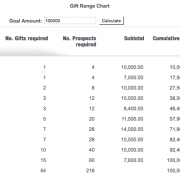
So, here is what a $100,000 fundraising goal would look like: https://www.blackbaud.com/nonprofit-resources/gift-range-calculator

How do you now use this information to inform your strategy?

  1. I would first look at the top gifts needed.  Here in this example, you would need 1 – $10K, 1 – 7.5K, 2 – $5K, and 3 – $3.5K for a total of $38K.  There are several options, right? You could write several grants.  In this case, you would need 28 grant possibilities, or you could approach a few major donors.
  2. Then if you look at your next tier of gifts, you would need $34K in gifts.  Perhaps you have a fundraising event, or maybe a direct mail campaign or a series of direct mail campaigns.  Or perhaps you continue to ask for gifts at this level.
  3. Maybe you look even further down and realize that you have a series of direct mail appeals, or that one appeal will do it for the remainder of the $28K or so.

The fact of the matter is that any possibility of a strategy will work, as long as it is realistic and fits for your organization. The key thing to remember is that you want to secure the top gifts first.  If you don’t raise those, then you need to readjust all the lower levels of the gift range chart below to “make up” for the difference.

Then, you can use this gift range chart as a monitoring and reporting tool. Let’s say that you are not hitting your “lead” gift targets.  Well, you can certainly adjust this gift range chart mid-course and make the necessary adjustments to your strategy BEFORE your fundraising efforts get too far off track.  And, this would be a great tool to share with your Board of Directors to educate them on the process of raising money and how your particular efforts are progressing towards projections.

So, though you may think that gift range charts are for the “big shops,” think again, a gift range chart can provide even the smallest campaign with focus and goals based on actualities and realities.

So, this next fiscal year why don’t you first start by creating a realistic gift range chart for your annual fund campaign and develop strategies to get you to your goal.


SaveSave

SaveSave

SaveSave

April 9, 2017/0 Comments/by hireacfre
Blog, Campaigns, Capital Campaigns, Donor relations, Individual Giving, Major gifts, Planned Giving

What’s next after your capital campaign feasibility study?

So, your consultant has just finished your capital campaign feasibility study.  The report is sitting on your desk, and you are wondering, where do I go from here?

Here are some possibilities:

The report may recommend that the organization takes some time to prepare its fundraising infrastructure before going into full campaign mode. Preparation may include things such as strengthening volunteer leadership, identifying campaign chairs, enhancing their fund development office, etc.  The organization should take the time to heed these recommendations and work either internally or with the/a consultant to strengthen some of the key identified areas before mounting a full capital campaign effort.

In some cases, the report may recommend that the organization move into full capital campaign mode.  In that case, the agency should seek to hire outside counsel either the firm that conducted the feasibility study process or another fundraising firm specializing in capital campaign management.

This report should be presented to the Feasibility Study Committee for review and once accepted by this committee; the committee should then give the report to the organization’s full Board of Directors for approval.  Once the Board approves, it should move to act on the recommendation found in the study.

In no shape or form, should this study be allowed to slip away or be placed on a shelf somewhere.  Time for action is now.  You do not want to lose the interest of donors and other key community members who have been part of the process and in some senses cultivated for a capital campaign effort.

In fact, the organization should share an abbreviated format of the study with these key donors and community members, and seek their opinions and possible engagement in the findings and campaign next steps.  The worst thing that can happen is that momentum is built through the study process and then grinds to a halt.

Accept the report, begin recommendation implementation, and engage key stakeholders throughout the process.

March 18, 2017/0 Comments/by hireacfre
Campaigns, Individual Giving, Major gifts, Planning, Resources for the professional, Small shop fundraising

More than just a monetary number – the capital campaign feasibility study

There are quite a number of groups seeking to test the feasibility of a possible capital campaign.

And, so naturally being a consulting firm catering to small fundraising shops, I tend to get asked to talk about these, and I am currently in the midst of one now.

What I find is that groups think that feasibility studies only test for one thing and that one thing is a financial goal.

I assert that there are many different types of things that a feasibility study tests for as a result.  Financial goals being just one.  In fact, more importantly, feasibility studies look at both internal and external perceptions and find areas of opportunities and challenges for an upcoming campaign.  Things such as “what about that large endowment the organization has?”  or “it doesn’t have strong fundraising leadership?” or “you need to ensure that so and so is on board and committed to launching a full-scale effort.”

Through a feasibility study, a group also finds out about potential campaign leadership, which by the way, can make or break a proposed capital campaign, other competing campaigns currently or just recently completed within the same community, and potential prospective donors to a capital campaign.  Also, a capital campaign feasibility study will unearth the general economic outlook both nationally and locally and how will that impact the success of a capital campaign.

So, as you can see, a feasibility study done correctly will provide lots of data that can then be used to refine the case for support, determine if it is time for the organization to mount a significant campaign, and what is the recommend campaign plan based upon findings as part of the study.  Oh, yes, and what fundraising goal will be feasible.

If you or your group is considering an upcoming capital campaign, I urge you NOT to skimp on the process of conducting a feasibility study.  You will learn more than just – can this campaign make a go of it.  You will find out exactly how much and how it can or cannot!

February 5, 2017/0 Comments/by hireacfre
Blog, Campaigns, Direct mail, Donor relations, Grant Writing, Individual Giving, Major gifts, Online, Planned Giving, Planning, Resources for the professional, Small shop fundraising

New “DCS” interim development services

Development Consulting Solutions is announcing NEW interim and project-based service offerings:

Who is “DCS”?
There are limited Certified Fund-Raising Executives (CFRE) providing outsourced fund development services and serving as interim fund development staffing. What most organizations need is someone who can do the work for them!

“DCS” recognizes this need and has provided this service to a variety of small to mid-sized nonprofits throughout the New England region. Some of these nonprofits have included Malta House of Norwalk, CT, Friends of Buttonwood Park of New Bedford, MA, and United Methodist Elder Care of East Providence, RI.

“DCS’s mission”
“DCS” does not engage with everyone! We have a rigorous eligibility requirement and screening process and only work with four select clients at a time.

What are our requirements? We only work with small to mid-sized organizations that are ready, receptive, and willing to take their development program to the next level through outsourced assistance. These organizations have an engaged Board of Directors, an open-minded and willing staff, and leadership ready to support the organization.

We only work with organizations that are willing to invest in their development function, value established service costs, heed professional advice, and strategy, and act respectfully in the client and consultant relationship.

By selecting those clients most ready to embark on taking their organization to the next level, “DCS” provides you with the tools and staffing to raise more money in support of mission!

Why “DCS?”

  • To provide outsourced development expertise to organizations that do not want to hire someone in-house.
  • To assist busy executive directors with taking a few things off their plates.
  • To reassure donors during a transition or vacancy in your development office that your fundraising efforts will continue
  • If time is needed to do a search for a permanent development director, and you do not want to be rushed to make a selection
  • When you are seeking a new executive director and you want to be sure that this leader has an opportunity to select the permanent development director
  • Because as interim development director, I can have more candid conversations with the executive director, board, and other leaders about why there are problems with keeping development staff or staff is underperforming
  • When your organization has never had a development director and needs an experienced professional with a proven track record to start up the development office and pave the way for a more junior development officer to be successful.

Here is what “DCS” can do for you:

  • Assess current fundraising activities and make recommendations to improve strategy
  • Improve your fundraising efforts
  • Model what a good development officer does
  • Enhance systems and processes within the development office
  • Troubleshoot development problems
  • Coach the Executive Director and Board in fundraising to boost confidence and skill
  • Help with the hire of a permanent development director

“DCS” helps with:

  • Major Gifts
  • Direct Mail Appeals
  • Development print publications – your newsletter, annual report, brochures, etc.
  • E-Appeals and E-Newsletters
  • Grants
  • Cultivation and Stewardship Events
  • Special Events
  • Capital Campaigns

For “DCS” pricing, please check out our menu of packages here!

January 15, 2017/0 Comments/by hireacfre
Campaigns, Individual Giving, Major gifts, Resources for the professional, Small shop fundraising

Is it time to go public with our campaign? Maybe, maybe not!

When to go public?

A question that I am asked a bit. When can our capital campaign go public? When can we put a thermometer out on our lawn? When can we start to ask our constituents and the general community? When can we have a special event and invite everyone?

The all important question, “is it time?”

My answer? Not until you have a certain number of lead gifts in hand. And, not before you have your institutional family committed to the campaign – folks like your Board of Directors, staff members, Campaign Steering Committee members, and your leadership donors.

Only when you have the majority of lead and family gifts in, is it time to broaden the focus and extend the solicitation process to more prospects through a more public campaign. Some say that you should have at least 50-70% of the entire gifts needed for the campaign in hand. But, one thing is for sure, the “Quiet” Phase is that indeed – quiet. There is no general advertising of the campaign or overall campaign fanfare.

Once you have a significant number of advanced gifts in hand, it is at this juncture that you should plan a campaign kickoff celebration event to aid in your project going “public.” This “public” phase is when the work of soliciting the organization’s broader constituency begins.

Then and only then should you put that “Community Thermometer” in the ground and start having your special shindig events.

So, is it time to go public – maybe or maybe not.  It all depends upon the science of campaigns and it is not something that you want to rush.

January 7, 2017/0 Comments/by hireacfre
Blog, Board development, Campaigns, Direct mail, Donor relations, Grant Writing, Individual Giving, Major gifts, Online, Planned Giving, Planning, Resources for the professional, Small shop fundraising

Do not take Fund Development best practices at face value!

Best practices. We hear that phrase often. This week, I even read a question asking if “best practices were misleading?”

Are we throwing that phrase around to legitimize our field? Our do we have best practices and what are they?Fundraising best practices

Well, I contend that the only true best practice is one that is grounded in research. Those are harder to find that than the other so-called “best practices.”

While studying for my Masters Degree in Philanthropy and Fund Development, I learned that philanthropic research has many gaps. However, there are people now making a study of philanthropy and conducting research. Folks like Adrian Sargeant and Jen Shang. More research is needed in our field to support our work.

I can tell you that when research is grounded in actual studies, it works. Eye motion studies, philanthropic psychology, etc., etc.

Recently, I have been working on many appeal letters. And, each time I craft one for the client, I get pushback. Why do you indent paragraphs? Why do you repeat yourself often? Why is there bold and underline? Do we need to include a P.S.? And, can’t the letter just fit on one page? Must we send more than one appeal?

Pushback that is unfounded. And, I push back with research. When the client allows me to use those best practices, the results speak for themselves.

When those results speak for themselves, it is magic. Campaigns get funded, new projects begin, and donors have the opportunity to make a greater impact.

We forget that the fact (and it is a fact) that we are not beggars. Donors want to give. And, to give, they must be asked. Asked in a way that moves them to feel connected to their core beliefs through your organization’s mission.

Know the difference between unfounded best practices and best practices backed by scientific research. Read blogs, stay current with trends, and keep furthering your informal and formal education. When you do, and you practice it, your results will show all the difference.

Fund development does have a researched body of knowledge. Don’t allow anyone to convince you that it does not.

December 3, 2016/0 Comments/by hireacfre
Blog, Board development, Campaigns, Individual Giving, Major gifts, Resources for the professional, Small shop fundraising

Yep, the Board does have a role in a capital campaign!

What, wait, we hired that Capital Campaign Consultant to run the campaign, and now you are telling me that I have to do something.  No, this can’t be possible.

Yep!  It would be unrealistic to think that a capital campaign is left up to the staff to manage.  How could they?  The staff doesn’t have access to donors and to peer networks?  A campaign is not a one, or two, or even three person job.  It is even more unrealistic to think that now the capital campaign consultant is in town, no one
needs to do anything period.

So, I know you’re shaking in fear that you might have to ask for money.  Well, yes, you may.  But, that is not your only role in a capital campaign.

When running a capital campaign, I meet with each of my campaign’s Board of Directors and review the Campaign Plan, goal, schedule, gift chart, and Case for Support.  I insist that they vote to approve these primary campaign documents.

And, I also share with them a Board commitment form that I have each and every one of them sign and date.

Board members have many responsibilities to a campaign. Below is my top ten list of capital campaign responsibilities and what I expect them to commit to:

  1. Not taking on any major new volunteer roles for other organizations and consider how to pare down current obligations and be accessible to the campaign.
  2. Review their philanthropic planning for the next year and perhaps beyond, as well as their calendars for those years.
  3. Consider what role they could and would like to play in the campaign. Every board member will be responsible for some part of the campaign and will be engaged in identifying and enlisting campaign committee members.
  4. Review their list of contacts – friends, neighbors, business associates – and carefully consider which of them may be interested in learning more about the organization.
  5. Review and approve the capital campaign plan as recommended by the capital campaign planning committee.
  6. Make a “stretch” gift to the campaign. 
Board members will all support the Annual Fund campaign each year in addition to supporting the capital campaign. All board members will participate financially in the campaign – to the best of their ability. The board will be the first to give. 
It is essential that other donors see 100% percent participation of the board.  It shows them that the board has the utmost faith, confidence, and enthusiasm for the organization.
  7. Ensure that contribution are used well and according to donor intent.
  8. Read all materials given to them by the organization and the campaign. Members of the community – donors, clients, friends, neighbors, etc. – will turn to the members of the board for guidance and information.
  9. Be an advocate for the organization, to the best of their ability, in the local and the wider community. Help expand the organization’s influence and exposure throughout the community by:

o   Securing the sponsorship of a community group to support the campaign.

o   Recruiting a speaker, host, or sponsor for a special event.

o   Arranging tours of the organization for interested individuals, corporations, foundations or others.

o   Hosting an event at their home, place of business or community organization.

o   Endorsing a solicitation made by the campaign leaders, either by phone or by letter.

o   Setting aside at least 20-30 minutes weekly to plan how to help the organization’s campaign.

o   Thanking donors and staying in touch keeping them informed of the project plans.

o   Evaluating the success of the campaign to determine strengths, areas of improvement and effectiveness of board policies and decisions.


SaveSave

November 12, 2016/0 Comments/by hireacfre
Blog, Campaigns, Donor relations, Individual Giving, Major gifts, Resources for the professional, Small shop fundraising

Sink or swim: the capital campaign steering committee

So, I have a niche somewhat of assisting smaller nonprofits with their capital campaigns.

This niche can be challenging because many of these groups have not had an ongoing, comprehensive fund Steering committee means campaign successdevelopment program in the past. However, working on these smaller campaigns can also be very satisfying because I can help them use this campaign to begin to develop these efforts.  I take those campaigns that a lot of other consultants won’t touch! Many while not having a sustainable donor base to build from, often needs a campaign without doing the preliminary feasibility study.  They need the money, and the campaign must go on.

In the process, there is one thing that I have come to realize.  The capital campaign steering committee is an absolute must.  And, for these smaller groups, it becomes the backbone of their campaign.  In forming this committee correctly, the group has the potential to propel the campaign forward.  Without this group, it may flounder.

And, this group can’t include just anyone.  It needs to include folks that can open doors to others have known networks, and believe in the cause.  They hold some of these smaller campaigns in the palm of their hand.

Without having a known, loyal donor base, this committee can introduce the campaign to a wider net of contacts who may be interested in learning more about the case.  They can leverage their networks to build relationships with, the can act as ambassadors for this campaign, and they can help, to ultimately build this organization’s future.

Not only that, this group can serve as a “feeder” system to the larger organization’s Board of Directors introducing them to a pool of prospective Board members who have deepened their engagement within the group.

Far too many smaller groups gloss over the importance of the who on this committee.  And, by glossing over the who, they are, in essence, glossing over what it takes to be successful in raising money for a capital campaign.  Let’s face it, without a loyal donor base, who else and how else are they going to get access to building one.

I purport that a committee group of connected individuals means success.  And, don’t settle for anyone who says less because they are just fooling you into believing that you can pull this stuff out of thin air.

Just saying, end of story!


November 5, 2016/0 Comments/by hireacfre
Blog, Campaigns, Donor relations, Individual Giving, Major gifts, Planning, Resources for the professional, Small shop fundraising

Holy cow, fifty shades of fundraising consulting, which do you prefer?

Lately, I have been doing a lot of driving.  And, as a result, a lot of thinking.  I have clients all throughout the Northeast.  And, sometimes, yes, the driving does get “old.”  But, then I sit back and reflect.

You see, there are many different types of fundraising consultants.  And, lately, I have been hearing a great deal about “remote,” “outsourced” development professionals as opposed to the strategic “tell me what to do” consultants that produce a plan and then move onto to the next client.  I do consider myself one of these, in fact, all of these.

But, perhaps I am old-fashioned.  Or maybe I just have been working in the field too long.  I remember, long ago, when there were resident consultants who upped and moved to different parts of the country to live and work at a nonprofit and become immersed in their community.

And, while I don’t up and move, I do spend lots of time on the move.  I think – no, wait, I believe it is critical to the success of my client’s efforts.  Yes, many of the things that I do while sitting in their organization can be done quite easily from home.  But, it is not the same.

Two weeks ago on my blog, I noted how “culture of place” is such an important part of our work.  How can you get to know and understand that “culture of place” if you are working remotely?  Or for that measure, how can you understand the mission and culture of the nonprofit that you are working for if you never sit at a desk and be a part of all that happens on a day to day basis.  What does this have to do with fundraising?  A lot!

It makes a big difference to the quality of work.  When I am onsite, I am a strong reminder to the client that we need to focus and get work done.  So, a lot of work gets done.  When I am not directly onsite, and I work remotely, it seems like work moves at a snail’s pace.  Emails are not answered with urgency, and meetings are postponed.  I get it.  I fall to the bottom of the list.  Very different than having a living, breathing person taking up precious space/rent or whatever you call it in your office as a good reminder.
And, the kinds of things that I do go far beyond just providing advice. I do the work. I craft appeal letters; write newsletter content, solicit donors, write Case for Supports, write grants, work on board development, manage capital campaigns, conduct feasibility studies and audits, on and on and on.

So, when you are thinking about consultants – yes, personality is important – yes, credentials and experience are important, but, don’t overlook the consultant’s personal philosophy of service provision.  Will they go the distance, sometimes hundreds of miles at a time, to live in hotels, to get your work done and to understand the context, both internally and externally, in which your work happens?

We don’t expect our staff development professionals to be in the office behind their desks, so why would you expect the same of a fund development consultant?  They need to be building relationships with organizations to create impact – just as fundraising professionals must be with donors.  It is just another extension of this donor-centered relationship – creating results and positive outcomes for a mission.

While the old models of “in-residence, uproot you and your family” are not so available today, I believe that my unique model of in-residence consulting of a set number of days per week/month onsite is an excellent compromise.  And, hey while I toot my own horn, my model makes a huge difference to my clients and sets me apart from the rest of the bunch.

See you on I95 or maybe I89 or maybe Rt 66.  But, you can be sure of one thing, you won’t see me sitting at my desk at home.

P.S. – Yes, these are photos from my travel.  When I say I get immersed in a community that I am working in, I do.  On a recent stay in a client’s town, I did go to the “Cow Barn” for milk for breakfast.  And, that stretch of road is I91 heading into a client’s town in Vermont from another client located in the Stamford area of CT.


October 15, 2016/0 Comments/by hireacfre
Blog, Board development, Planning, Resources for the professional, Small shop fundraising

How well are you meeting your nonprofit’s mission?

How big is your need?

Interestingly enough, a group that I am currently working with is in the process of conducting an outside needs assessment.  I think this is such a wise move.  Are you assessing your community need?

Over the years, I have led strategic planning and board development for quite some time.  For those groups who have engaged me in the past for strategic planning, I strongly advocate that we take the time to do a full stakeholder assessment component through a comprehensive market research plan.  Many groups, move ahead without me and without doing that needs assessment.

Well, one of the primary objectives of strategic planning is to determine if an organization is still relevant to the community that it serves.  And, if the community has changed, how will they choose to respond to the findings, if at all.

The pure fact of the matters is that we are here to serve our stakeholders. We have a mission to serve a community to meet a need.  Do we ever stop and assess how well we have met that need?  Or have we ever stopped to assess to determine if that need still exists?  Or if it exists, is it still in the same form and shape?

Demographics and populations change quite naturally as society does.  Technology, societal views, cultural shifts may impact a demographic and their life choices, etc.

Do we as organizations make the assumption that the demographic and social ill that we were founded to alleviate, in some cases twenty years or more is still the same?

Are we making decisions based on old paradigms or trends or social problems?

How do we ensure that our organizations are still relevant?  And, that our mission is impactful?

Or are we ensuring that we don’t go out of business because failure to look at the community means that we don’t have a look at whether or not we are needed any longer and to what degree?

I applaud this group for taking this step and for assessing their community.  The data is rich.  And, it will inform future discussions around mission and direction, about fundraising and case for supports, about capital campaigns, etc., etc., etc.

I urge you to take the same steps, and then to ask the tough question – what does relevancy mean? And, are we still relevant to those that we serve?

And, folks, this is the realm of governance.  Something that your board should be asking and looking at in-depth.


July 24, 2016/0 Comments/by hireacfre
Page 1 of 212

Like DCS on Facebook

Latest Posts

  • 5 Tips for Converting Crowdfunders to Lifetime DonorsMarch 24, 2022 - 2:06 am
  • Here’s the Checklist You Need to Create a Communications Plan for your Nonprofit’s Next Fundraising Campaign!Here’s the Checklist You Need to Create a Communications Plan for your Nonprofit’s Next Fundraising Campaign!March 11, 2022 - 1:53 am
  • Social Media for Nonprofits: A Brief Guide to Boosting Your Year-End Fundraising Revenues through Social Media6 Ways to Use Social Media to Boost Your Calendar Year-End Fundraising RevenuesOctober 29, 2021 - 11:53 am
  • What Data Should You Leverage From Your Donation Form?October 14, 2021 - 9:15 am

Newsletter

Fill out this form to sign up for our email newsletter

Contact

Development Consulting Solutions
New Bedford, MA
(508) 685-8899
[email protected]
Join Our Community

idda-linkedin-badge

Schedule Free Session

Schedule your first 30-minute complimentary session to see if we are a great fit!

Book Now

Quick Links

  • Visit us on Facebook
  • Visit us on X
  • Visit us on LinkedIn

Join our Newsletter

Fill out this form to sign up for our email newsletter

© Copyright - Development Consulting Solutions | Privacy Policy
  • Twitter
  • Facebook
  • LinkedIn
Scroll to top